
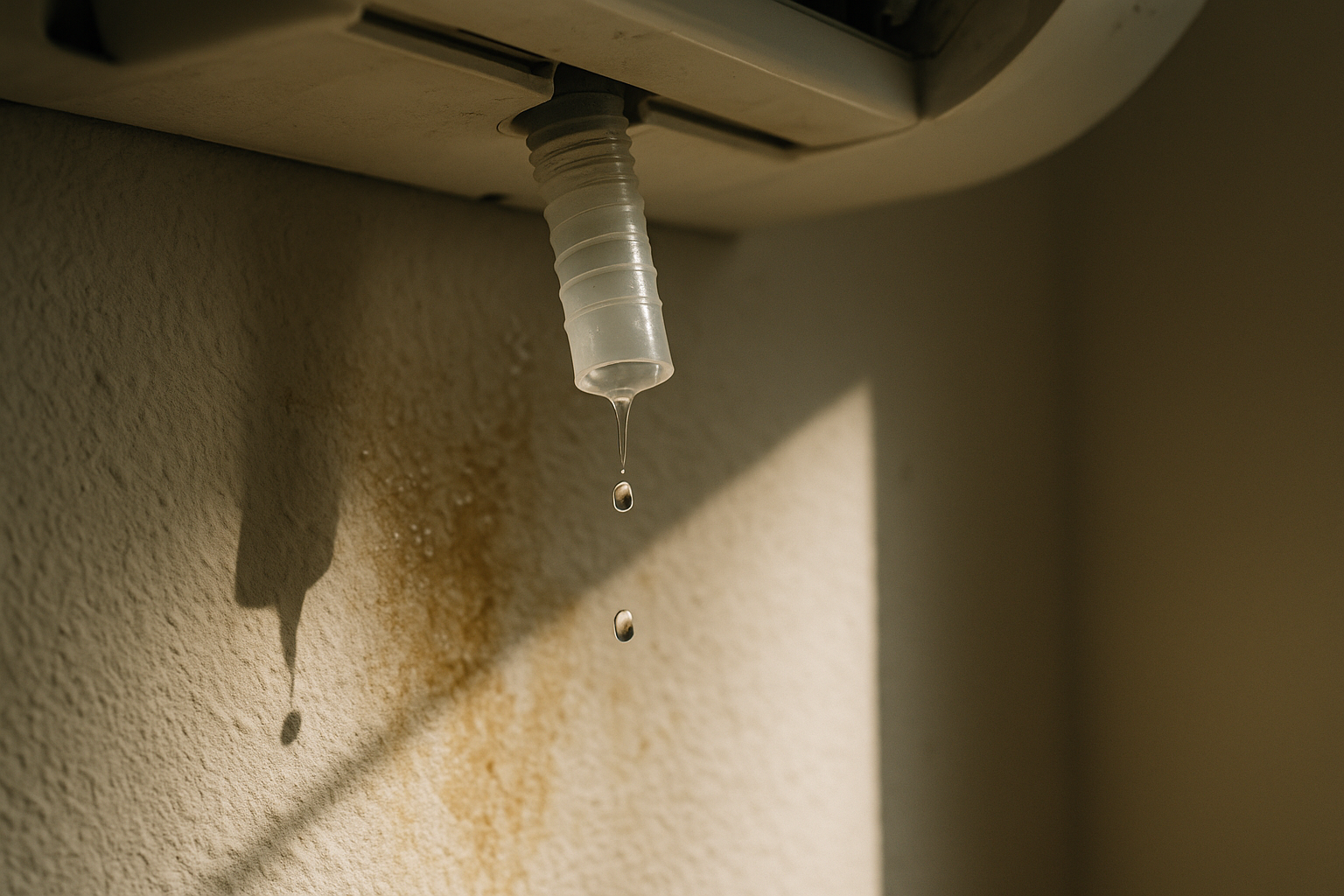
If you live in Little Elm and your AC has barely shut off in the last 48 hours, you’re not imagining it. With a 114° heat index warning active today, every air conditioner in North Texas is working harder than it was built to run comfortably for this long — and that means one quiet, easy-to-miss problem is popping up all over the metroplex right now: AC condensation lines backing up and overflowing.
It sounds small. It isn’t. A backed-up drain line can dump gallons of water into your attic, behind a wall, or under your flooring before you ever notice a drop on the ceiling. So today, before you do anything else, I want you to go check on your unit. It’ll take five minutes.
Why extreme heat causes this specific problem
Your AC doesn’t just cool air — it pulls moisture out of it too. That water collects in a drain pan and runs out through a condensate line, usually a PVC pipe near your outdoor unit or a small drain near your indoor air handler.
When it’s 114° outside, your system runs almost nonstop to keep up. More runtime means more condensation, more volume moving through that little line, and more pressure on any weak point — a clog of algae, a kink in the line, a drain pan that’s already cracked or full. Under normal conditions, a slow drain might never cause trouble. Under today’s kind of extreme heat AC failure conditions, it overflows fast.
What to check right now
- The drain pan under your indoor unit (usually in a closet, attic, or utility room) — is there standing water, or has it overflowed onto the floor?
- The PVC drain line outside — is water actively dripping from it? A steady drip is normal when the AC is running hard. No drip at all, when you know the unit’s been running, can mean it’s clogged and backing up somewhere else instead.
- Ceiling stains, soft spots, or a musty smell near where your air handler sits, especially if it’s in an attic above living space.
- The float switch, if your system has one — it’s designed to shut the AC off before an overflow happens, but it can fail or get stuck.
If you find standing water or active dripping somewhere it shouldn’t be, turn the AC off at the thermostat and call an HVAC tech today — not next week. That part’s outside our lane, and I’ll always point you to the right pro for it.
Where this turns into water damage
Here’s the part that worries me most: condensation leaks are quiet. They don’t flood a room in one dramatic afternoon — they drip steadily into an attic, a wall cavity, or subfloor for days before anyone notices a stain or a soft spot. By the time it’s visible, the moisture has often already soaked insulation, drywall, or wood framing underneath.
And in this heat, warm, wet, dark spaces are exactly where mold gets a head start. Moisture is always the root of that problem — heat just speeds up the clock.
If you find water damage today
Day one is about stabilizing, not about having every answer. Get the water source stopped, get the standing water out, get air moving and drying equipment on the affected area, and reassess in 24–48 hours once things have had a chance to respond. That rhythm gives you — and your insurance company, if it comes to that — real information instead of guesswork.
One honest note: once drying equipment is running, it needs to keep running until the structure actually reads dry, not just looks dry. I know the fans are loud and disruptive. I can’t promise it won’t be — but I can promise to make it as least disruptive as possible, and turning equipment off early just invites the same problem back later, worse.
We’re local, and we’re keeping an eye on this heat wave
Merlene Mitigation is based right up the road in Pilot Point, and we’re watching this heat event closely because we know what it does to AC systems across Denton County and Little Elm. No crew, no call center — when you call, you’re talking to the person who’ll actually show up.
If you’ve found water where you shouldn’t have, or you’re just not sure whether what you’re looking at is a real problem, give us a call. No pressure, no upsell — just an honest look at what’s going on.
-Ally
Leave a Reply