Tag: water damage prevention

  • AC Condensation Leaks in Denton, TX: Prevent Water Damage Now

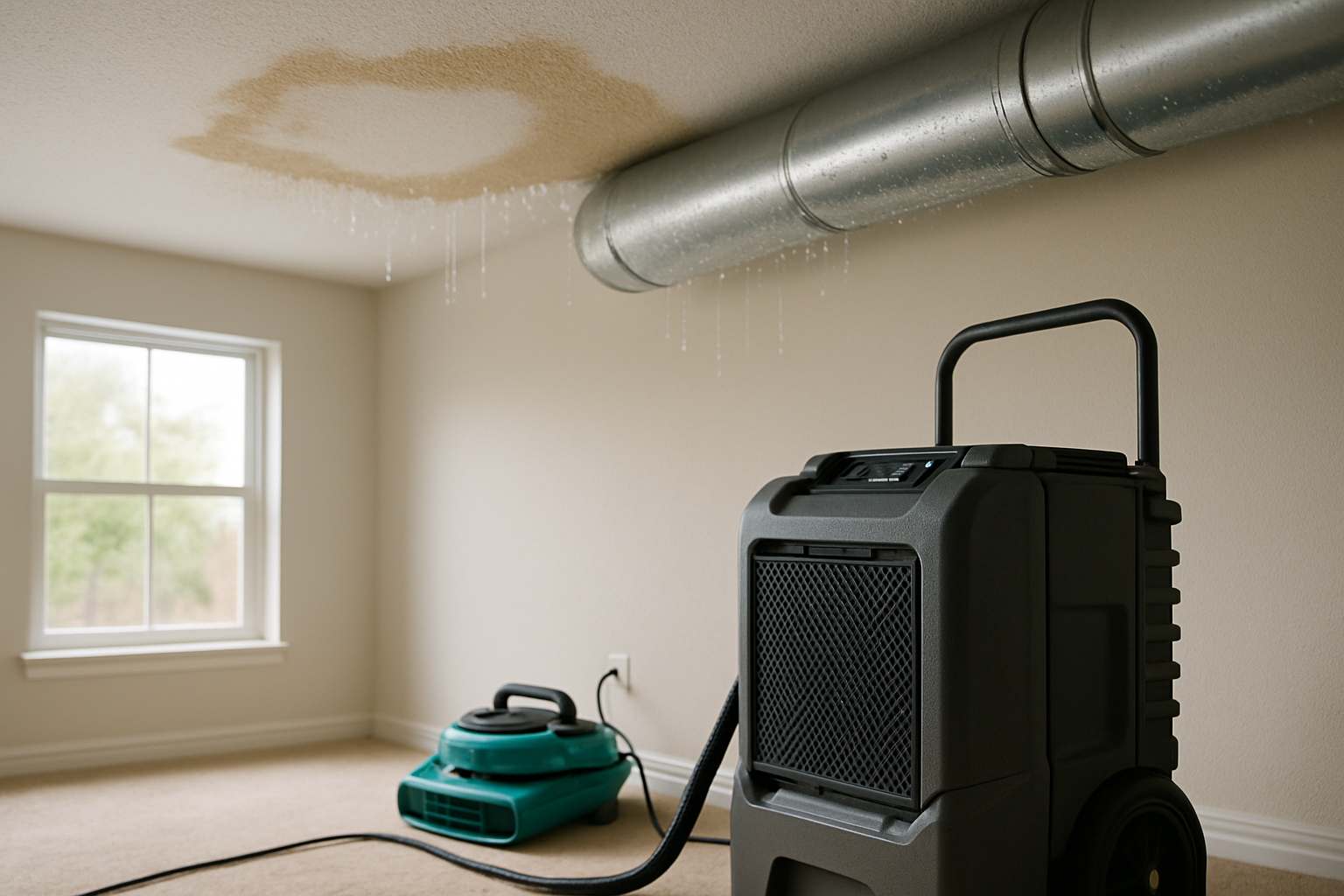
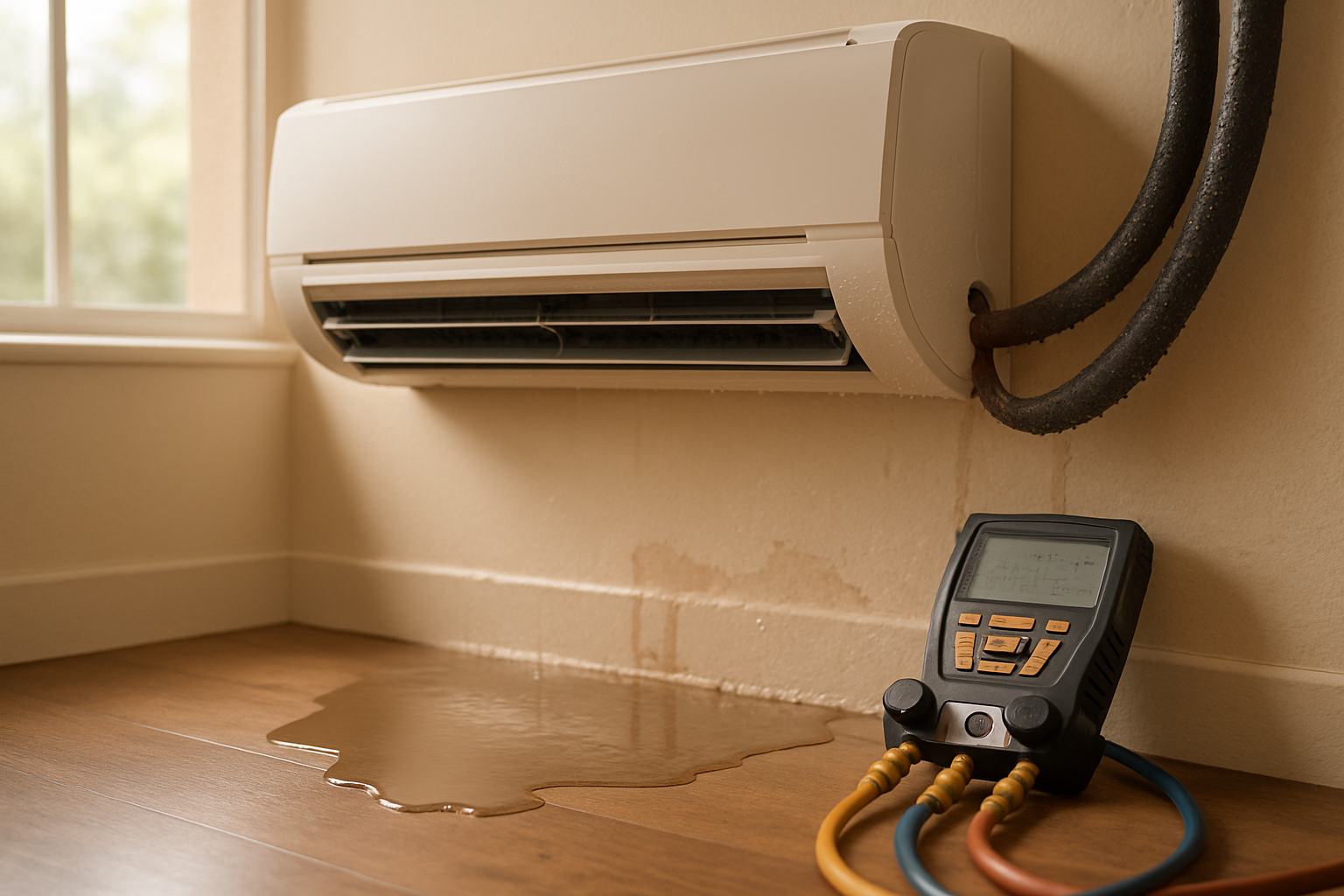
    If your AC has been running nonstop this week, you’re not imagining it. With heat index values pushing past 105° across Denton and the rest of North Texas, every air conditioner in the county is working harder than it has all year. And there’s a quiet side effect of that extreme heat that catches a lot of homeowners off guard: the drain line that carries condensation away from your AC unit can clog, back up, and overflow, sometimes right into your ceiling or wall before you ever notice a drop.

    I want to walk you through why this happens during heat waves specifically, what to check today, and what to do if you’re already seeing signs of trouble.

    Why heat waves cause AC condensation leaks

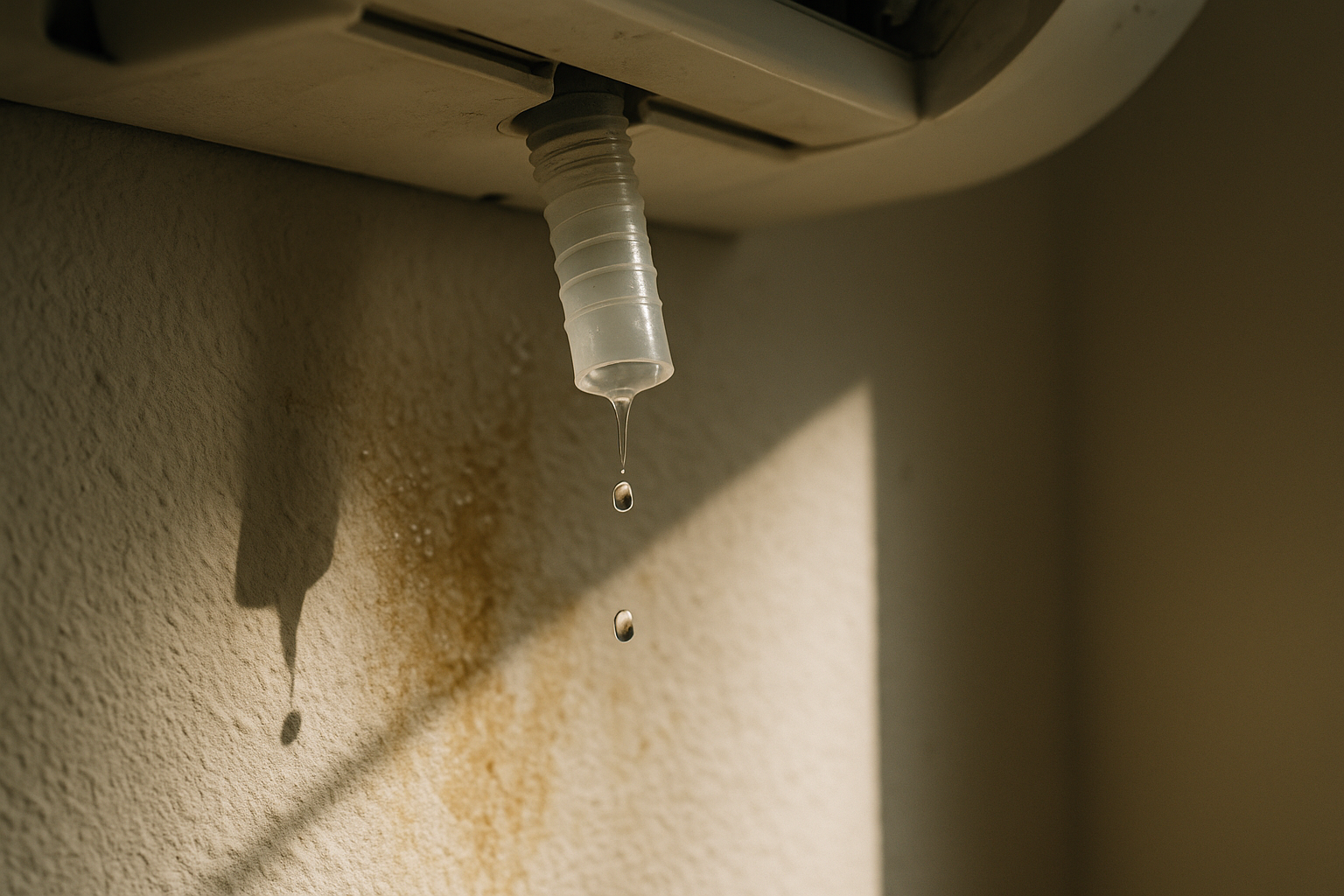
    Your air conditioner doesn’t just cool air, it pulls moisture out of it. That moisture collects on the evaporator coil and drips down into a condensate drain pan, then runs out through a small PVC drain line, usually to the outside of your house.

    When it’s this hot, your system runs longer and more often, which means it’s pulling more moisture out of the air than usual. More condensation means more water moving through that little drain line. If there’s even a small clog already forming, extreme heat is what pushes it past the tipping point and into an overflow.

    Algae, dust, and gunk build up in these lines slowly over months. You usually don’t notice until a heat wave asks more of the system than it’s been asked to do all year. That’s exactly what’s happening across Denton and North Texas right now.

    Signs your drain line may already be backing up

    • A musty smell near a vent, closet, or the ceiling below an attic AC unit
    • Water stains or a soft spot forming on the ceiling under an attic-mounted air handler
    • Standing water in the drain pan, or around an indoor unit in a closet or utility room
    • Your AC randomly shutting off (many systems have a safety switch that kills the unit when the pan overflows, which is actually a good sign your system is protecting your home)
    • Visible water or damp drywall near where ductwork or the air handler sits

    If you catch it at the “safety switch tripped” stage, you’re in good shape. If you’re seeing a stain spreading on the ceiling, that tells you water has already been sitting somewhere it shouldn’t for a while.

    What to check today, before it becomes an emergency

    You don’t need any special tools for a basic AC drain inspection. Here’s what I’d walk through in my own house:

    1. Find your drain line’s outdoor exit, usually a white PVC pipe near your outdoor unit or along the side of the house. Water should be flowing freely when the AC is running. No flow at all can mean a clog upstream.
    2. Check the drain pan under an attic or closet air handler for standing water or rust.
    3. Look at the ceiling directly below an attic unit for any discoloration, sagging, or a faint yellow-brown ring.
    4. Listen for your system cycling oddly or shutting off and back on more than usual.

    If everything looks dry and the drain is flowing, you’re probably fine, just keep an eye on it through the rest of this heat spell. If you see any standing water or staining, that’s worth acting on now rather than waiting.

    Why this matters more than it looks like it does

    Here’s the thing about AC condensation leaks: the surface almost always looks fine long after the real damage has started. A small ceiling stain can mean insulation, drywall, and framing above it have already been wet for days. Moisture that sits in a wall cavity or attic space in 105° heat is exactly the environment mold needs to get going. It doesn’t take long.

    This is the same principle behind any water intrusion, hidden moisture is the real threat, not the puddle you can see. If you’re not sure whether what you’re looking at is “just a stain” or something that needs a real moisture check, that’s a fair thing to want a second opinion on.

    If you’re already dealing with water damage from an AC overflow

    Turn the AC system off at the thermostat (not the drying equipment if a restoration company already has fans running, that’s a different situation, and that equipment needs to stay on to do its job). Contain what water you can with towels, and get eyes on it, whether that’s your own or a professional’s, sooner rather than later. The first 24 to 48 hours matter more than people expect.

    I’m based in Pilot Point and serve Denton and the surrounding North Texas towns. Josh personally handles every inspection and every job, no crew being dispatched, no stranger showing up you’ve never talked to. If you’re seeing signs of an AC drain overflow or just want a second set of eyes before this heat wave does more damage, call or text anytime. Because it’s just Josh running things, overhead stays low and so do the prices, and you always know exactly who’s showing up.

    And if today isn’t an emergency day but you’d rather be ready before one happens, our free guide, The First 24 Hours After Water Damage, walks through exactly what to do first and why. Worth five minutes now so you’re not guessing later.

    -Ally

  • AC Condensation Leaks During Heat Waves: Quick Prevention Guide

    If your AC has been running nonstop since sunrise, you’re not imagining it. With the heat index sitting around 108° here in Pilot Point this week, air conditioners across Denton County are working harder than they’ve worked all year — and that’s exactly when condensation leaks turn into water damage calls.

    Here’s the good news: a five-minute check today can save you a soaked ceiling or a ruined closet floor tomorrow. Let’s walk through it.

    Why extreme heat causes AC overflow

    Your air conditioner doesn’t just cool air — it pulls moisture out of it, and that moisture has to go somewhere. Normally it drains quietly through a condensate line to the outside. But when your system runs for hours on end without a break, like it’s doing right now in this heat, it produces more condensation than usual, faster than usual.

    If that drain line is even partly clogged with algae, dust, or a buildup of gunk, the extra water backs up. It fills the drain pan, overflows, and finds the nearest path down — usually through a ceiling, into a closet, or along a wall you won’t notice until the stain shows up.

    This is the single most common cause of water damage calls we see during a North Texas heat wave. It’s quiet, it’s slow, and it usually starts long before anyone notices.

    Your same-day heat wave checklist

    Take ten minutes today, while it’s still light out, and run through this:

    • Find your indoor AC unit (usually in a closet, attic, or utility room) and look for a drain pan underneath it. Is there any standing water?
    • Check the condensate drain line — the PVC pipe running from the unit to the outside. Is water actually dripping out of it, or has it gone dry when the system is clearly running?
    • Look up. If your AC is in the attic, check the ceiling below it for any soft spots, discoloration, or a faint water stain. Catching this early is everything.
    • Check the safety float switch, if your system has one. It’s a small device in the drain pan designed to shut the AC off before it overflows. If yours doesn’t have one, it’s worth asking your HVAC tech about adding one before next summer.
    • Pour a cup of water into the drain line access point (if you have one) to see if it flows freely. If it backs up, the line may already be clogged.
    • Set a phone reminder to check again this evening. Peak stress hours are the hottest part of the afternoon into early evening — exactly when a marginal clog turns into an overflow.

    If you find water — what to do first

    If you catch standing water in the pan or a wet spot on the ceiling, don’t panic, but don’t ignore it either. Turn the AC off at the thermostat to stop adding more water, and if it’s safe to do so, place towels or a shallow container to catch what’s already draining. Then get eyes on it — either yours or a professional’s — as soon as you can.

    Here’s the honest truth about water and drywall or insulation: it looks dry on the surface long before it actually is. Even a small overflow can leave hidden moisture in a ceiling cavity or wall for days, and that’s exactly the kind of thing that turns a cheap fix into an expensive one if it sits.

    I can’t promise a heat wave like this one won’t cause a few surprises this week — but I can promise that catching it early, and handling it right, makes all the difference between a quick dry-out and a much bigger repair.

    We’re right here in Pilot Point

    Merlene Mitigation is local — based right here in Pilot Point, not a call center somewhere else in the state. If you find water damage from an AC overflow, or you’re just not sure whether what you’re looking at is a real problem, give Josh a call or send a text. He personally handles inspections and can usually be on-site within the hour for real emergencies. No crew of strangers, no guesswork — just one accountable person who’ll tell you straight what you’re dealing with and what it actually takes to fix it.

    And if today isn’t an emergency day but you’d rather be ready before one happens, we put together a free guide called The First 24 Hours After Water Damage. It walks through exactly what to do in that first day — worth five minutes now, so you’re not scrambling later.

    Stay cool out there, Pilot Point.

    -Ally

  • AC Condensation Leaks in Aubrey, TX: Prevention Guide

    If you’ve walked past your air conditioner today and heard it running nonstop, that’s not your imagination. With the heat index sitting around 107° across Aubrey and the rest of North Texas this week, your AC is working harder than it has all year — and that’s exactly when condensation drain problems show up.

    Here’s the thing most homeowners don’t know until it happens to them: the same system keeping your house cool is also pulling gallons of water out of the air every single day. All that water has to go somewhere. Usually it drains out quietly through a small line you never think about. But when that line clogs, or the pan underneath it overflows, that water ends up in your ceiling, your walls, or pooled on the floor next to your unit — and you may not notice until there’s a stain or a soft spot.

    Why extreme heat makes this worse

    During a heat warning like this one, your AC runs longer cycles, more often, for days on end. More runtime means more condensation produced, which means more strain on that little drain line and pan. A clog that would’ve been a minor drip in April can turn into a steady leak in July — right when everyone’s system is maxed out and it’s hardest to get a same-day appointment with anyone.

    An AC drain clog in Aubrey, Texas doesn’t usually announce itself with a bang. It’s slow. A little water damage today, a little more tomorrow, until you’re looking at a stained ceiling or warped flooring and wondering how long it’s actually been going on.

    Your 10-minute prevention checklist

    Good news — most of this you can check yourself, today, before it becomes a problem:

    • Look at the drain pan. If your unit is in an attic or closet, there’s a secondary pan underneath. Check it for standing water — that’s an early warning sign the primary line is clogged.
    • Check the condensate line outside. It’s usually a white PVC pipe near your outdoor unit. It should be dripping steadily in this heat. If it’s bone dry while your AC is running, that’s a red flag — the water’s backing up somewhere instead of draining out.
    • Look for a musty smell or damp spot near your indoor unit, closet, or the ceiling below an attic unit. Algae and gunk build up inside that drain line over time, especially in summer, and that smell is often the first clue.
    • Test the float switch, if your system has one. It’s a small safety switch designed to shut the AC off before the pan overflows. If yours is old or was never installed, that’s worth mentioning to your HVAC tech.
    • Don’t ignore a warm house with a running AC. Sometimes the first sign of an overflow issue is the safety switch doing its job and shutting the system down. If your AC won’t turn on and it’s tripped that switch, there may already be water where you can’t see it.

    If you find water damage

    If you do find damage — a soft ceiling spot, a wet patch of carpet, warped baseboards — please don’t wait it out to “see if it dries on its own.” Hidden moisture inside drywall or under flooring doesn’t dry the way a wet countertop does, and it’s exactly the kind of thing that turns into a mold problem if it sits for a few days in this heat and humidity.

    I can’t promise it won’t be disruptive to get it properly dried out — but I can promise to make it as least disruptive as possible, and to walk you through exactly what’s happening at every step.

    You’re not just calling “a company”

    When you call Merlene Mitigation, you’re calling Josh — the person who shows up, does the inspection, and stays on your job from start to finish. No call center, no rotating crew of strangers. Lower overhead means fair, honest pricing, and one accountable person who treats your home like his own. That’s the whole idea behind MM: I’m on your team, not just on the clock.

    If you’re in Aubrey, Pilot Point, or anywhere in the surrounding North Texas area and you’re seeing signs of an AC leak or water damage this week, give Josh a call or shoot a text — texting is easy and a lot of people prefer it, especially when they’re not sure yet if it’s a big deal or not. Either way, you’ll get a straight answer.

    And if nothing’s wrong today but you’d rather be prepared than caught off guard, grab our free guide, The First 24 Hours After Water Damage. It’s free, it’s genuinely useful, and it’s the kind of thing you’ll be glad you read before you need it instead of after.

    -Ally

  • AC Condensation Leaks in Cross Roads, TX: Heat Warning Checklist

    If you live in Cross Roads and your AC has been running nonstop the last day or two, here’s something worth checking before you head to bed tonight: the little drain line tucked behind or under your air handler. With the Extreme Heat Warning in effect and heat index values climbing to 108–109°F, that small line is doing the hardest work in your whole house right now, and it’s exactly the kind of thing that fails quietly, at 2am, while everyone’s asleep.

    I want to walk you through why that happens and what you can actually do about it tonight, no tools or expertise required.

    Why extreme heat is brutal on your AC’s drain line

    Your air conditioner doesn’t just cool your house, it pulls moisture out of the air too. On a normal summer day, that condensation drips into a pan, runs down a small PVC line, and exits outside without you ever thinking about it.

    But on a day like today, with the system running almost continuously to keep up with 108-plus heat index values, your AC is pulling far more moisture than usual, for far longer stretches. That means more condensation, more volume through that drain line, and more opportunity for a clog, a crack, or a slow leak to turn into standing water on your ceiling or in your closet.

    This is one of the most common causes of water damage we see in North Texas during heat warnings like this one, and it’s almost always preventable if you catch it early.

    Your extreme heat AC checklist tonight

    • Check the drain pan. If your unit is in the attic or a closet, look underneath it for any standing water or dampness. Even a small amount is worth taking seriously.
    • Look for a wet or musty smell near vents or the attic access. Your nose will often catch a slow leak before your eyes do.
    • Check ceilings under attic units for staining or soft spots. A yellowish ring or a spongy patch on drywall is often the first visible sign of a slow leak that’s been building for hours or days.
    • Find your emergency shutoff switch. Most units have a float switch that should shut the AC off automatically if the pan fills, but it’s worth knowing where the breaker or disconnect is, just in case.
    • If you see active dripping, turn the system off and call for help. Running it longer just adds more water to a problem that’s already started.

    What NOT to do

    If you do find water, please don’t try to “wait it out” until the heat breaks. A saturated ceiling or wall doesn’t dry on its own just because the AC finally catches a break, and left alone, that moisture is exactly what invites mold to take hold. Once drying equipment is in place, it needs to keep running, even though the fans are loud and honestly a little annoying. I know that’s not what anyone wants to hear during an already miserable heat wave, but it’s the part that protects your home from a much bigger, much more expensive problem down the road.

    If something’s already dripping tonight

    Here’s the honest truth: I can’t promise a night like this won’t be disruptive if you do find a leak. What I can promise is that the first hours matter more than almost anything else. Getting water stopped, extracted, and drying started quickly is what keeps a small, cheap problem from becoming a big, expensive one.

    Merlene Mitigation is a small, local, owner-operated company based right here in Pilot Point, and Josh personally handles inspections and water damage calls throughout Cross Roads and the surrounding area. No call center, no subcontracted stranger, just one accountable person who’ll walk you through exactly what’s happening and why. Because there’s no big overhead here, that personal attention comes without the big-company price tag.

    If you’re dealing with a leak tonight, or you just want a second set of eyes on that drain line before the heat warning lifts, you can call or text Josh directly. If he doesn’t pick up right away, it’s likely because he’s already on a job, he’ll call back with an ETA as soon as he’s free.

    And if tonight’s all clear for you, that’s great, take the two minutes to grab our free guide, The First 24 Hours After Water Damage, so you know exactly what to do if a night like this ever catches you off guard.

    Stay cool out there, Cross Roads.

    -Ally

  • AC Condensation Leaks in Denton: Heat Emergency Checklist

    AC Condensation Leaks in Denton: Heat Emergency Checklist

    If your AC has been running nonstop the last couple of days, you’re not imagining it. With an Extreme Heat Warning in effect across North Texas and heat index values pushing near 108°F, every air conditioner in Denton County is working harder than it’s designed to run for this long. And when AC systems work overtime, condensation drain lines are exactly what tends to fail first.

    Here’s the part most homeowners don’t know until it’s too late: a clogged or failing drain line doesn’t announce itself with a bang. It shows up as a quiet drip in the attic, a soft spot in the ceiling, or a puddle by the closet where nobody thought to look. By the time you notice, water’s often already found its way into drywall, insulation, or flooring.

    The good news is this is one of the easiest things to catch early, if you know where to look. Here’s a five-minute checklist you can run through today.

    Your 5-Minute AC Leak Checklist

    1. Check the drain pan under your indoor unit

    If your air handler is in a closet, attic, or garage, take a look at the drain pan underneath it. Standing water, rust, or a musty smell means water isn’t draining the way it should.

    2. Look at the PVC drain line outside

    Most systems have a white PVC pipe that exits near the outdoor unit or along the side of the house. It should be dripping steadily in this heat — that’s normal. What’s not normal is no drip at all (possible clog) or water pooling right at the base of the house (possible blockage forcing water back inside).

    3. Feel around the ceiling below the attic unit

    If your air handler is in the attic, walk the rooms underneath it. Run your hand along the ceiling for any spot that feels cool, soft, or damp. Discoloration — even a faint yellow or brown ring — is worth taking seriously, even if it’s small.

    4. Check for a musty smell near vents or closets

    Moisture has a smell before it has a visible stain. If a room smells “off” and you can’t place why, that’s reason enough to look closer.

    5. Listen for the secondary drain pan alarm

    Many systems have a float switch that shuts the AC off if the primary drain backs up. If your unit has randomly stopped cooling, this might be why — and it’s actually doing its job protecting your home.

    Why This Matters More During a Heat Emergency

    During normal weather, a slow drain leak might take weeks to cause real damage. During a stretch like this, with the system running almost continuously to keep up with 108° heat index days, that same leak can dump a lot more water in a lot less time. What would’ve been a minor drip in April can become genuine AC overflow damage to a ceiling or wall in the middle of a July heat wave.

    The moisture itself is only half the problem. Warm, humid North Texas air sitting inside a wet wall cavity is exactly the environment mold needs to get started — often within 24 to 48 hours.

    If You Find Water

    If you catch a leak in progress, the biggest favor you can do yourself is act fast. Get towels down, move anything valuable out of the way, and if it’s safe to do so, shut off the AC unit until it can be looked at — but don’t unplug or disable anything you’re not sure about, and don’t assume a small stain means a small problem underneath it. Surfaces dry a lot faster than the structure behind them, and what looks fine on top can still be holding water where you can’t see it.

    I can’t promise every leak is a quick fix — sometimes it’s a five-minute drain clear, sometimes it’s more. But I can promise a straight answer about which one you’re dealing with, and a plan to handle it without any surprises along the way.

    If you’re in Denton, Pilot Point, or anywhere around North Texas and you’re staring at a wet ceiling or a mystery stain right now, give Josh a call or shoot a text — that’s often the fastest way to reach him, especially when he’s already out on a job. He’s typically on-site within the hour for anything urgent, and you’ll be working directly with the person who’s actually going to fix it — not a call center, not a stranger. That’s the whole point of a small, local operation.

    And if nothing’s leaking today but you’d rather be ready before it happens, our free guide, The First 24 Hours After Water Damage, walks through exactly what to do in those first critical hours. Worth five minutes now, so you’re not searching for answers later.

    -Ally

  • AC Condensation Leaks in Aubrey, TX: What to Check Now

    AC Condensation Leaks in Aubrey, TX: What to Check Now

    If you’re in Aubrey today, you already know it’s brutal out there. With the heat advisory pushing the heat index to 104°, your air conditioner is working harder than it has all year — running longer cycles, pulling more moisture out of the air, and putting more strain on parts that quietly fail without warning. One of the most common: the AC condensation drain line.

    Here’s the thing about a condensation leak — it rarely announces itself with a dramatic gush. It’s a slow drip, tucked inside a wall cavity or above a ceiling, doing damage for days before anyone notices a stain. And on a day like today, with the system running nearly nonstop, that slow drip has a lot more opportunity to become a real problem.

    So before you do anything else this afternoon, take five minutes and check these things. It’s the kind of five minutes that saves you a much longer week.

    Why heat advisories are prime time for AC drain failures

    Your AC doesn’t just cool the air — it pulls humidity out of it, and that moisture has to go somewhere. It collects in a drain pan and exits through a condensation line, usually a thin PVC pipe running out near your foundation or into a drain.

    On a normal day, that system handles a manageable amount of water. On a 104° day, with the unit running almost continuously to keep up, it’s processing far more condensation than usual. If there’s already a partial clog — algae, dust, a bit of sludge buildup — today is the day it finally backs up and overflows.

    Your 5-minute checklist, right now

    • Look at the drain pan. If you have an indoor unit in a closet or attic, check the pan underneath it for standing water.
    • Check the drain line outside. Find where the condensation line exits your house (often near the outdoor unit) and confirm water is actually dripping out. No drip during a heavy-run day like today is a red flag — it likely means a clog upstream.
    • Look up. If your air handler is in the attic, check the ceiling below it for any new discoloration, soft spots, or a faint musty smell.
    • Check around vents and the unit itself for any dampness, drips, or a puddle that wasn’t there yesterday.
    • Listen for your float switch. If your system suddenly shuts off entirely, don’t panic — that may actually be a safety switch doing its job, stopping the unit before an overflow gets worse. It’s uncomfortable, but it beats the alternative.

    If you find standing water or a stain, turn off the AC at the thermostat and, if you’re comfortable, at the breaker. Yes, it means an uncomfortable house on a 104° day. That’s a real trade-off, and I won’t pretend it isn’t. But letting the unit keep running while it’s actively overflowing can turn a small, contained issue into water working its way through drywall, insulation, and framing — which is a much bigger job than anyone wants.

    What happens if water’s already gotten into the structure

    If you’ve caught actual damage — a stained ceiling, damp drywall, a soft spot underfoot — the surface being dry to the touch doesn’t mean the structure underneath is dry. That’s one of the most common myths in this business, and it’s the reason small leaks turn into mold problems weeks later. Moisture hides in places you can’t see or touch, and that’s exactly where trouble grows.

    This is where a proper inspection matters — checking moisture content in the material itself, not just what’s visible on the surface, so you know the true extent before it’s a bigger, more expensive fix.

    We’re here for it, Aubrey

    Merlene Mitigation is based just up the road in Pilot Point, and we handle water damage and inspections all across North Texas — Aubrey included. Josh is the one who answers the phone and the one who shows up, so you’re not getting bounced between a call center and a rotating crew. Lower overhead means fair pricing, and one accountable person means nothing gets lost in translation.

    If you’re seeing signs of an AC leak today, give us a call or shoot a text — Josh is usually on-site within the hour for situations like this, and texting works great if a phone call isn’t convenient in the moment.

    And if nothing’s leaking today but you’d rather be ready than sorry, we put together a free guide called The First 24 Hours After Water Damage. It walks through exactly what to do the moment you find water, before help arrives — worth having on hand long before you ever need it.

    Stay cool out there, Aubrey.

    -Ally

  • AC Condensation Leaks in Providence Village: Heat Advisory Checklist

    AC Condensation Leaks in Providence Village: Heat Advisory Checklist

    If you’re in Providence Village today, you already felt it walking to your car this morning — that thick, heavy heat that hits you like a wall. With a Heat Advisory in effect and the heat index climbing to 107°, your AC system is working harder than it has all summer. And that means today is exactly the kind of day AC condensation leaks turn into real water damage, sometimes without you knowing it until the ceiling stain shows up.

    I want to walk you through why this happens and what to check right now, while there’s still daylight and time to catch it early.

    Why heat advisories are prime time for AC leaks

    Your air conditioner isn’t just cooling the air — it’s pulling moisture out of it too. That moisture has to go somewhere, and normally it drains out through a small condensate line to the outside of your home.

    On a mild day, that line handles the job fine. But on a day like today, with the heat index near 107°, your system runs longer and harder, pulling more moisture out of the air than usual. That means more condensation, more water moving through that drain line, and more pressure on any weak point — a clog, a crack, a sagging section of pipe — that might’ve been just barely holding on.

    Add in an older unit, a slightly tilted drain pan, or a line that hasn’t been cleaned out in a while, and you’ve got the perfect setup for an overflow. And because the attic or closet where your unit lives isn’t somewhere most people check daily, that water can sit and soak for hours — even overnight — before anyone notices.

    What to check right now

    This takes about ten minutes and could save you a much longer, much more expensive problem down the road:

    • Look at the drain pan under your indoor unit. Any standing water, rust, or visible cracks?
    • Check the drain line itself — it’s usually a white PVC pipe running from the unit to the outside. Is water actually dripping out of it? If nothing’s coming out, that can mean a clog, not a good sign.
    • Feel the ceiling below your attic unit (if that’s where yours is) for any soft spots, discoloration, or a faint musty smell.
    • Check closets or utility rooms near your unit for damp carpet, warped baseboards, or a smell that wasn’t there yesterday.
    • If you have a float switch (a small safety device that shuts the AC off if the pan overflows), make sure nothing’s blocking it and that it hasn’t already tripped.

    If you find standing water or active dripping somewhere it shouldn’t be, that’s your sign to act today, not this weekend. Heat and humidity like we’re seeing right now are exactly the conditions mold needs to get started, and it doesn’t wait for a convenient time.

    Small leak now, bigger problem later

    Here’s the honest truth: a lot of AC condensation leaks look minor at first. A little staining on a ceiling tile, a damp patch of carpet. But drywall, insulation, and subfloor hold onto moisture long after the surface looks dry, and that hidden dampness is where real structural damage and mold growth take hold — often out of sight, in places you won’t think to check until it’s much further along.

    Catching it today, while it’s small, is always the cheaper and simpler path.

    If you find water damage, here’s what matters first

    If you do find a leak that’s already caused damage, the first priority is getting the area drying — extracting standing water, getting air moving, and getting a moisture reading on what’s underneath the surface. Surfaces dry fast. What’s underneath takes real equipment and a little patience.

    If you’re in Providence Village or anywhere else in North Texas and you’re staring at a wet ceiling or a soaked closet floor today, give us a call or send a text — I’m easy to reach either way, whichever’s more comfortable for you. Josh is usually on-site within the hour for things like this, and he’ll walk you through exactly what’s going on and what it’ll take to fix it, no runaround.

    And if today isn’t your emergency, but you want to be ready in case a day like this ever turns into one, I put together a free guide called The First 24 Hours After Water Damage. It’s the same steps I’d walk you through myself, just ready before you need them.

    Stay cool out there today, and don’t be afraid to go check that drain line.

    -Ally

  • AC Condensation Leaks in Cross Roads, TX: What to Check Now

    AC Condensation Leaks in Cross Roads, TX: What to Check Now

    If you’re in Cross Roads today and your AC has been running nearly nonstop, I want you to do one thing before you keep reading: go look at your indoor unit. A heat advisory with a heat index near 108° is exactly the kind of stretch that pushes AC systems past their limit, and condensation drain lines are one of the first things to fail when a system runs this hard for this long.

    Here’s the good news. Checking it takes about three minutes, and it might save you from coming home to a soaked ceiling or a warped hallway floor tomorrow.

    Why heat like this causes water damage, not just high bills

    Your AC doesn’t just cool the air, it pulls moisture out of it. All that moisture has to go somewhere, and normally it drains out through a small condensate line, either into a drain pan, out an exterior line, or into your plumbing.

    When it’s 108° outside, your system runs longer and harder to keep up, which means it’s pulling more moisture out of the air than usual, more often. A drain line that’s been slowly building up algae or dust all summer suddenly can’t keep pace. It backs up. And once it backs up, that water doesn’t stay politely in the pan. It finds the nearest ceiling, wall cavity, or closet floor.

    This is one of the sneakier ways water damage happens in North Texas. No storm, no burst pipe, just a hardworking AC system and a clogged line, quietly doing damage for hours before anyone notices.

    Your 3-minute check, right now

    • Find your indoor unit — usually in a closet, attic, or utility room.
    • Look at the drain pan underneath it. Any standing water, even a little, means the line isn’t draining properly.
    • Check the PVC drain line coming off the unit. Follow it to where it exits outside, often near your outdoor condenser or through an exterior wall. Water should be dripping or flowing there when the AC is running. If it’s bone dry while the system is cooling, that’s a red flag — the water is going somewhere else.
    • Look up. If your unit is in the attic, check the ceiling below it for any soft spots, discoloration, or a fresh water stain.
    • Feel around the base of the unit and nearby drywall for dampness or a musty smell.

    If you see standing water in the pan or dampness anywhere nearby, that line is likely clogged or already overflowing. Turning the thermostat down further won’t help — it’ll just make the unit work harder and push more water through a line that’s already struggling.

    What to do if you find a problem

    If you catch it early, a clogged condensate line is a fairly simple fix for an HVAC tech. The real risk isn’t the clog itself, it’s what happens when it goes unnoticed for a day or two: soaked insulation, stained ceilings, and moisture sitting inside your walls where you can’t see it — which is exactly the kind of thing that turns into a mold problem if it dries on its own timeline instead of the right one.

    If you’re already seeing active water damage — a wet ceiling, water coming through a light fixture, or standing water on the floor — that’s not a wait-and-see situation. The faster water gets extracted and the area starts drying properly, the smaller and cheaper the whole thing stays.

    If it’s already happening

    I’ll be honest with you: I can’t promise a heat-advisory week like this one won’t be disruptive. What I can promise is that if you call, you’re getting one person — Josh — who shows up, assesses it honestly, and tells you exactly what needs to happen and why. No call center, no stranger subcontractor, no upsell. Just a straight answer from someone who treats your house like it matters, because it does.

    If you’re in Cross Roads, Pilot Point, or anywhere nearby and you’re looking at water you didn’t expect, give Josh a call or send a text — texting is often the fastest way to reach him, especially midday when he may already be on another job. He’ll get you an honest ETA and a plan.

    And if today’s a good day and nothing’s leaking, that’s the best time to get ready for the day something does. Our free guide, The First 24 Hours After Water Damage, walks through exactly what to do in that first critical stretch — no pressure, just the plan, so you have it before you ever need it.

    -Ally

  • AC Condensation Leaks in Denton, TX: Why 105° Heat Causes Failure

    AC Condensation Leaks in Denton, TX: Why 105° Heat Causes Failure

    If you can hear your AC running almost nonstop today, you’re not imagining it. With the heat advisory in place and the heat index pushing 105° across Denton County, every air conditioner in North Texas is working harder than it was designed to work for hours at a stretch. And when an AC system runs that hard, that long, something else starts working overtime too: your condensation drain line. Today’s the day it’s most likely to fail — and it can do it quietly, behind a wall, for hours before anyone notices.

    Why heat like this causes leaks, not just discomfort

    Your AC doesn’t just cool air — it pulls moisture out of it. That moisture collects as condensation and is supposed to drain out through a small line, usually PVC, that runs from the indoor unit to the outside of your house.

    On a normal day, that line handles a manageable amount of water. On a 105° heat index day, your system is running longer cycles, pulling more moisture out of the air for more hours in a row, and pushing more water through that same small line. If there’s even a partial clog — algae, dust, a bit of debris — today is the day it backs up and overflows.

    That’s the quiet part of an AC overflow. It doesn’t announce itself with a bang. It shows up as a stain on the ceiling below the attic unit, a damp spot near the closet where your indoor unit lives, or water pooling in the drain pan and finding its way past it. By the time you see it, it’s often been dripping for a while.

    What to check today, right now

    None of this takes special tools — just a few minutes and a flashlight.

    • The drain pan under your indoor unit. If your unit is in a closet or attic, look for standing water in the pan or on the floor around it.
    • Ceiling below the attic unit. A yellowish stain, a soft or sagging spot, or new discoloration is a sign water has already found its way through.
    • The outdoor drain line termination. This is usually a white PVC pipe near your outdoor unit. Water should be dripping from it steadily on a day this hot. If it’s bone dry while your AC is clearly running, that’s a red flag — the water may be backing up somewhere else instead.
    • Musty smell near vents or closets. Moisture sitting behind drywall or under flooring often announces itself with smell before it shows visibly.
    • Your float switch, if you have one. Some systems have a safety switch that shuts the AC off when the pan overflows. If your AC suddenly stopped cooling on a day this hot, this could be why — and it’s actually doing its job.

    If you find water

    Don’t panic, but don’t wait, either. A small leak today can mean saturated drywall, insulation, or subfloor by tomorrow — and once that happens, it’s not something a fan and an open window will fix. Moisture trapped inside a wall or under flooring needs real drying equipment to pull it out fully; surface-dry isn’t the same as structure-dry, and that gap is exactly where hidden mold risk lives.

    If you catch it early, turn the AC off at the thermostat to stop feeding the leak, mop up what you can see, and get eyes on it — either an HVAC tech for the mechanical side, or a water damage professional if there’s already saturation in drywall, flooring, or insulation.

    We’re here if today’s the day

    I’m not going to pretend I know whether this is a five-minute clog or something that’s already spread further than it looks — that’s exactly what an inspection is for. Josh has been doing this work for over 12 years, and he’ll tell you straight what he’s seeing and what it actually needs, not what’s easiest to sell.

    Merlene Mitigation is based right here in Pilot Point, and Josh personally handles every water damage inspection — no call center, no subcontractor you’ve never met. That keeps things honest, and it keeps the price fair.

    If you’re in Denton or anywhere in North Texas and you’re looking at a wet drain pan or a stained ceiling right now, call or text Josh. He’s typically on-site within the hour for situations like this.

    And if today isn’t your emergency but you want to know exactly what to do the moment it is, grab our free guide, The First 24 Hours After Water Damage. It’s the same plan we’d walk you through on the phone — just ready before you need it.

    -Ally