
Tag: water damage

  • Water Damage After Summer Storms? Here’s What to Do First

    Water Damage After Summer Storms? Here’s What to Do First

    If you’ve lived in North Texas longer than one summer, you already know the drill: blue skies at lunch, sirens by supper. July is peak severe thunderstorm season here, and along with the hail and the wind comes the thing that quietly does the most damage — water. A roof leak you didn’t know you had, a window that let in more than it should have, a slab that took on water faster than the yard could drain it.

    The good news? What you do in the first 24 hours matters more than almost anything else. Here’s exactly what to do, in order.

    1. Make sure everyone’s safe first

    Before anything else — no wet electrical, no wading through standing water near outlets or panels, no walking under a sagging ceiling. If there’s any doubt about structural safety or electrical hazards, wait for it to be checked before you go back in.

    2. Stop the source, if you safely can

    If it’s a plumbing issue, shut off the water at the main. If it’s a roof leak, a tarp or bucket is a fine stopgap until help arrives — just don’t get on a wet roof in a storm to do it. Your job right now is damage control, not repair.

    3. Document before you touch anything

    This is the step most homeowners skip, and it’s the one insurance adjusters care about most. Before you move furniture or start mopping:

    • Take photos and short videos of every affected room, from multiple angles
    • Capture the water line on walls or baseboards if there is one
    • Photograph damaged belongings before you move them
    • Note the time and rough cause (“hail broke a window, rain came in around 3pm”)

    You can start cleanup right after — you don’t have to wait around. Just get the pictures first. It takes five minutes and it can save you real headaches later.

    4. Get the water out and start drying — fast

    This is where the clock really matters. Mitigation professionals talk about a golden window of about 24–48 hours before wet materials start growing mold and secondary damage sets in. That’s not a scare tactic — it’s just how moisture and organic material behave in Texas humidity.

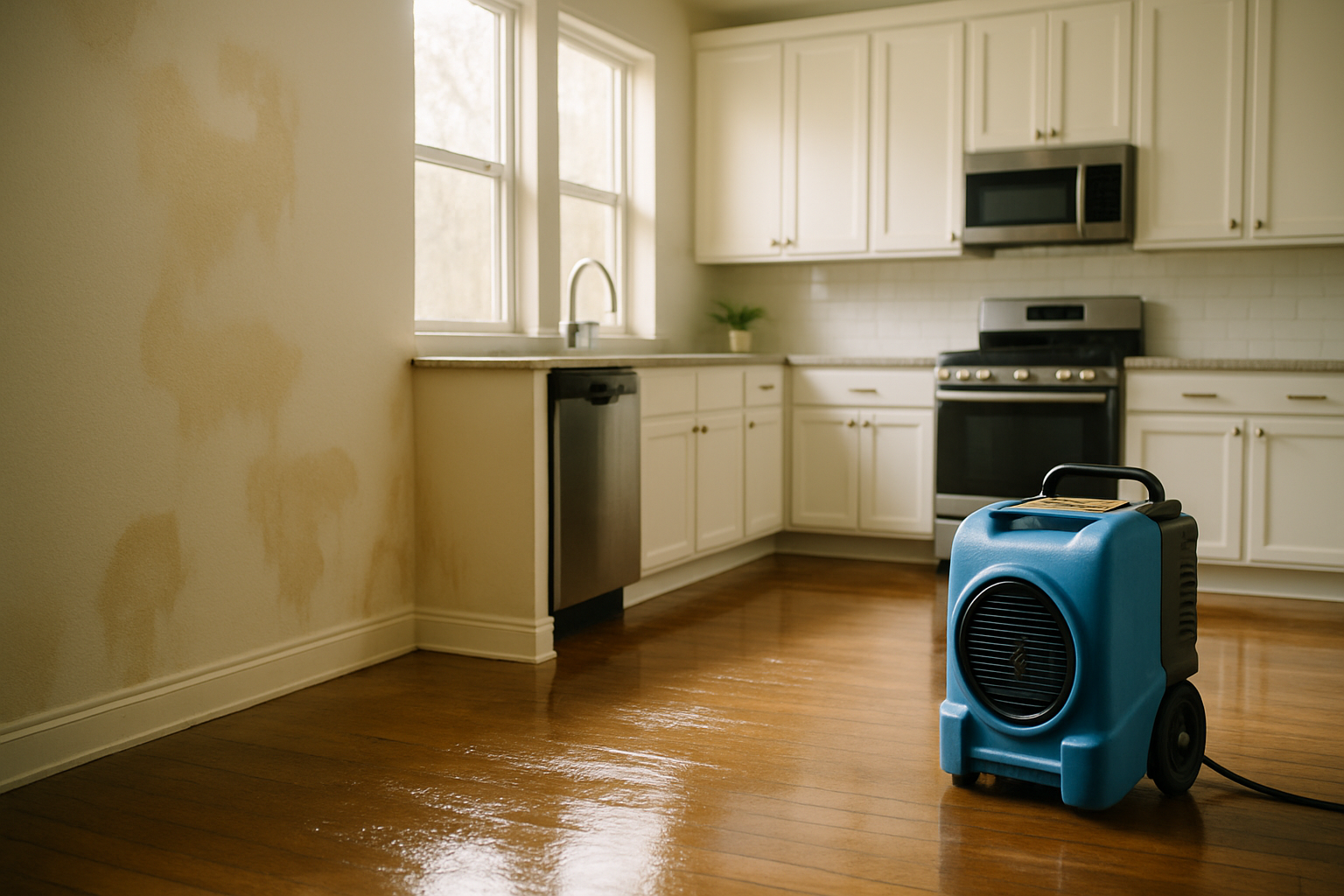
    Here’s the honest sequence, the same one we use on every job: Day one is about stabilizing. Get standing water out, apply an antimicrobial to slow microbial growth, and get drying equipment running — real air movers and commercial dehumidifiers, not the little unit from the laundry room. Then, within 24–48 hours, we come back and reassess the whole area with moisture meters and a thermal camera to see what’s actually still wet underneath the surface. That second look lets everyone, including your insurance company, catch up before big decisions get made.

    I know the fans and dehumidifiers are loud and disruptive — genuinely, choose your sanity, put on a podcast, get the kids outside for a bit. But please don’t turn the equipment off early, even for a few hours. Structural drying only works if it runs uninterrupted, and shutting it down risks the mold and secondary damage it’s there to prevent.

    5. Call a professional when…

    • Water touched drywall, insulation, subfloor, or has been sitting more than a couple hours
    • You can’t tell how far the water traveled (it almost always travels farther than it looks)
    • There’s any hint of a musty smell already
    • You just want a second set of eyes before you decide anything

    Surface-dry is not the same as actually dry. That’s the single most common thing homeowners get wrong, and it’s the reason “small” water events turn into expensive ones.

    The Merlene Mitigation way

    I’m not going to promise this won’t be disruptive — it will be, for a while. What I can promise is we’ll make it as least disruptive as possible, and we’ll be honest with you every step of the way about what’s actually needed and what isn’t. Josh handles water damage and inspections personally — you’re not getting handed off to a stranger — and because Merlene Mitigation runs lean, you get personal attention and fair pricing instead of franchise overhead.

    If you’re dealing with storm damage anywhere in Pilot Point or the surrounding Denton County towns, give us a call. Even if it’s just to talk through what you’re looking at and figure out your next step, we’re glad to help.

    -Ally
  • AC Condensation Leaks: Why Extreme Heat Causes Water Damage

    AC Condensation Leaks: Why Extreme Heat Causes Water Damage

    If you’ve stepped outside today, you already know: this isn’t just “hot,” this is heat-index-112°F hot. Your AC has been running almost non-stop trying to keep up, and honestly? So has everyone else’s in North Texas. But here’s something most homeowners don’t think about until it’s too late — all that extra air conditioning means your system is producing more condensation than usual, and that condensation has to go somewhere. When it doesn’t, you can go from “my AC is working hard” to “I have water damage in my hallway” surprisingly fast.

    Let’s talk about why this happens on days like today, and what you can check right now to stay ahead of it.

    Why extreme heat makes condensation leaks more likely

    Your air conditioner doesn’t just cool the air — it pulls moisture out of it too. That moisture collects on the evaporator coil and drips down into a condensate drain line, which carries it outside or into a drain.

    On a normal day, that system handles the job just fine. But on a day like today, with your AC running for hours longer than usual, it’s producing far more condensation, far more often. That’s a lot more water asking a small drain line to keep up.

    And condensate lines are notorious for small blockages — algae, dust, a bit of debris — that don’t cause problems under normal conditions but become a real bottleneck when the volume spikes. When the line clogs, that water doesn’t just disappear. It backs up into the drain pan, and if the pan’s overflow safety switch isn’t working (or doesn’t exist, on some older systems), it spills over — often right into your attic, ceiling, or a closet near the air handler.

    What to check right now

    You don’t need any special tools for this — just a few minutes and a flashlight.

    • Find your indoor air handler (often in a closet, attic, or utility room) and look at the drain pan underneath it. Is there standing water?
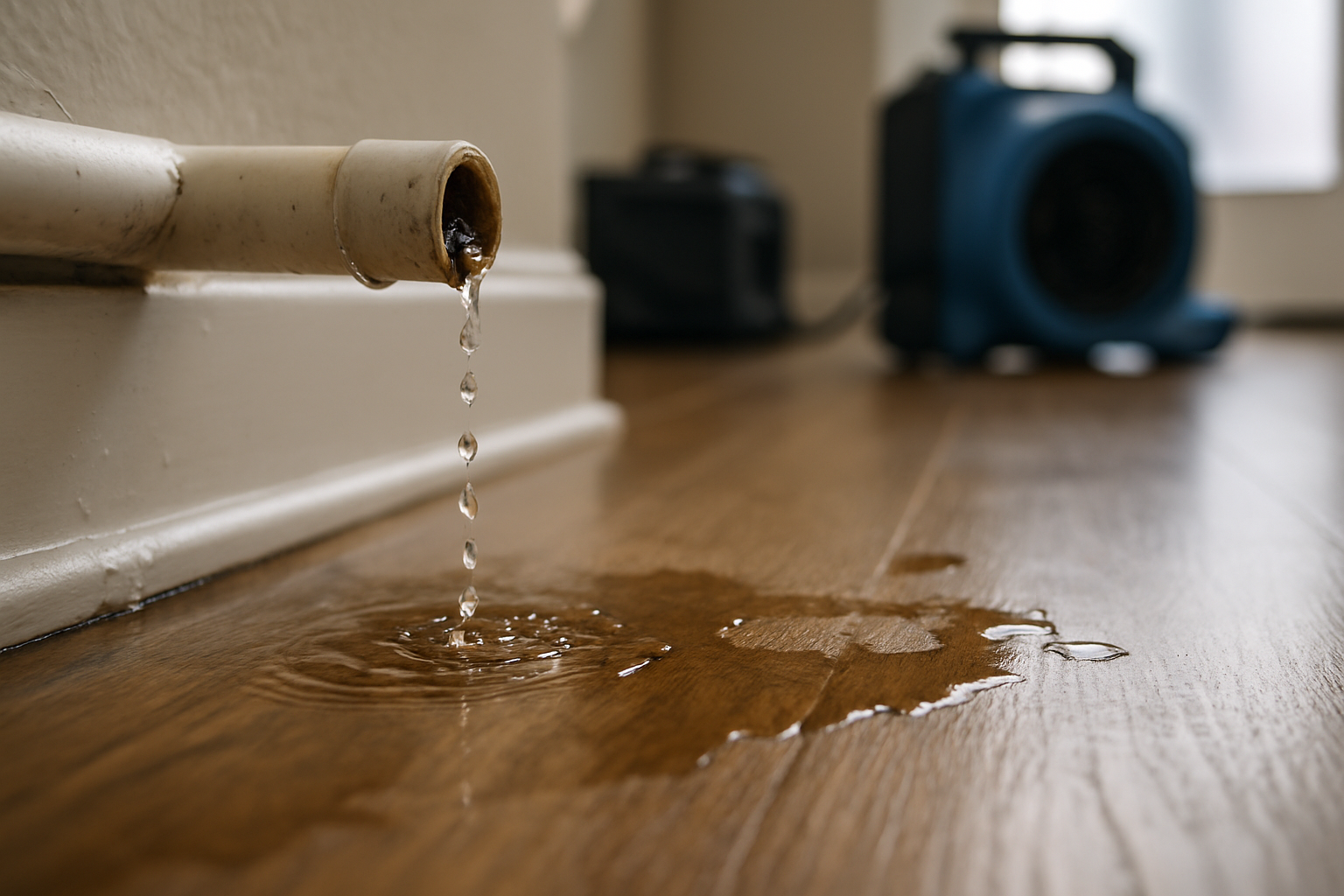
    • Check the condensate drain line — usually a white PVC pipe running outside your house near the unit. Water should be dripping from it steadily on a hot day like today. If it’s bone dry and your AC has been running for hours, that can be a sign of a clog upstream.
    • Look for a shutoff switch or float switch near the pan — if the pan fills too high, this is supposed to shut the AC off before it overflows. Worth knowing whether yours has one.
    • Check the ceiling below or around the air handler for any soft spots, discoloration, or a musty smell — early signs of a slow leak that’s already begun.

    If you find standing water or a soft ceiling spot, that’s your sign to call an HVAC tech and start looking into the water damage before it spreads further.

    Why this matters more than it seems

    A condensate overflow is quiet. It doesn’t sound dramatic like a burst pipe, and it usually starts as a slow drip rather than a flood. That’s exactly what makes it dangerous — by the time you notice a stain on the ceiling, there’s a real chance the insulation, drywall, or framing above it has been wet for days. And where there’s been trapped moisture for a while, mold risk goes up fast, especially in this heat and humidity.

    If you’re already dealing with a wet ceiling, soaked insulation, or that telltale musty smell, the same rule applies as any other water event: the sooner it’s dried out properly, the smaller and cheaper the problem stays.

    If it’s already happened

    Turn off the AC unit at the breaker if you see active water coming from the air handler — better safe than sorry — and call an HVAC technician to address the actual clog or mechanical issue. Once the water source is handled, don’t just let the area air dry on its own. Trapped moisture in insulation, drywall, and framing needs real moisture mapping and proper drying equipment, not just an open window and a fan.

    I can’t promise it won’t be a hassle — a soggy ceiling never is — but I can promise to help you understand exactly what’s going on and make the process as painless as it can be.

    If you’re in Pilot Point or anywhere in North Texas and you’re staring at a wet ceiling or a mysterious puddle today, give us a call. I’m happy to talk you through what you’re seeing, no pressure, no upsell — just genuinely trying to help you figure out your next step in this heat.

    -Ally