
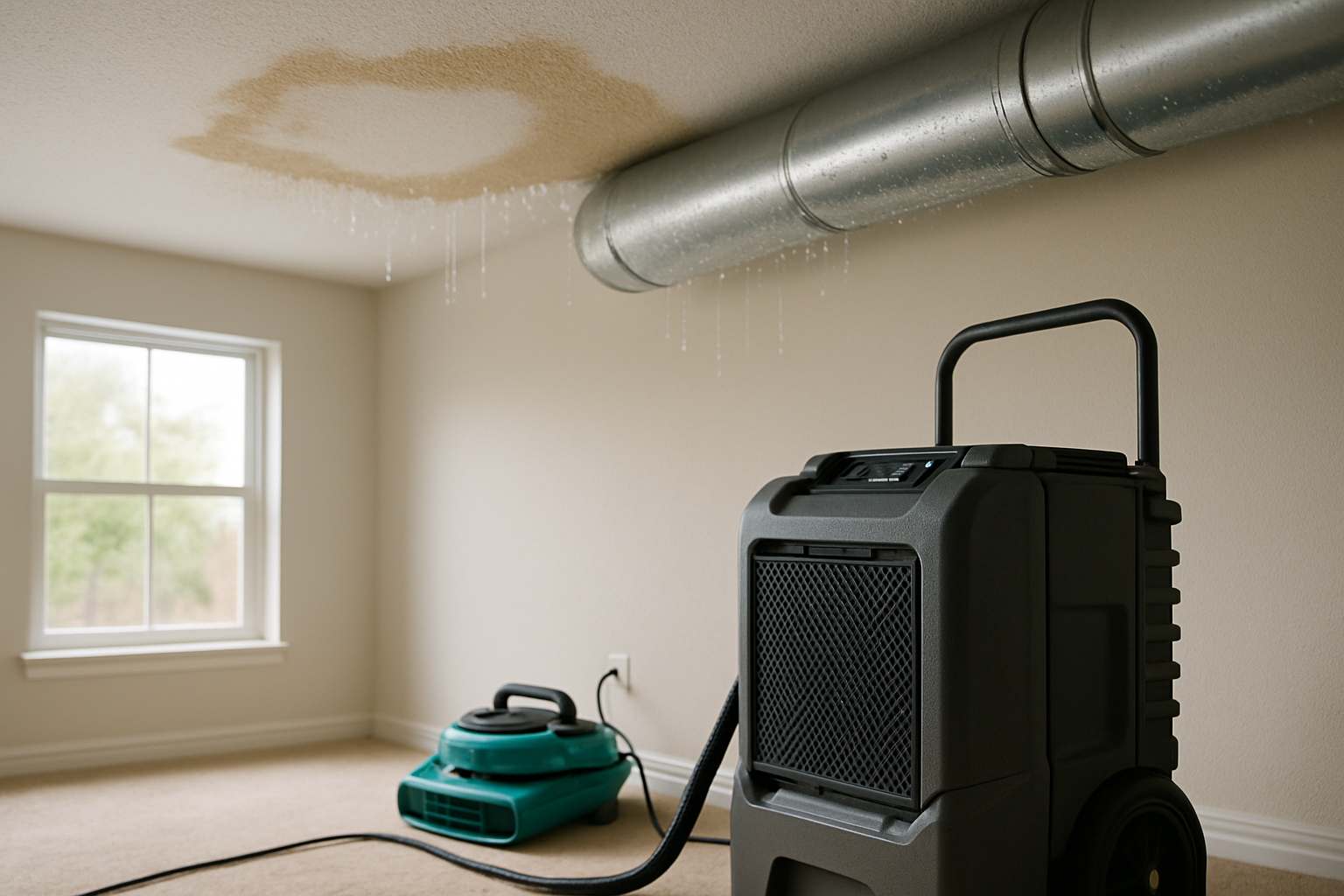
If your AC has been running nonstop since sunrise — and it probably has — you’re not imagining it. With today’s heat index climbing to 113° here in North Texas, your system is working harder than it has all year. And a hardworking AC system is exactly when small drainage problems turn into a puddle in the hallway or a stain spreading across the ceiling.
Here’s what’s actually happening, what to watch for, and what to do if you spot trouble.
Why extreme heat causes AC leaks
Your AC doesn’t just cool air — it pulls moisture out of it, and that moisture has to go somewhere. Normally it drips into a condensate pan and drains outside through a small line. On a mild day, that’s a slow trickle. On a 113° heat index day, your system is running longer and harder, pulling way more moisture out of the air, and that condensate line is handling a lot more volume than it was ever really tested on.
Two things tend to go wrong:
- The drain line clogs. Algae, dust, and gunk build up over time. Add a heavy load of condensation and a partial clog becomes a full blockage — the water backs up and finds the nearest low point, which is often your attic insulation, a ceiling, or a closet floor.
- The coil freezes, then floods. Ironically, a system straining in extreme heat can ice over if airflow is restricted (dirty filter, low refrigerant, blocked vents). When that ice melts, it doesn’t drip — it dumps, all at once, faster than the drain pan can handle.
Warning signs worth checking today
None of these take more than a few minutes, and all of them are worth doing before you go to bed tonight while the system keeps grinding away:
- A musty smell near a vent, closet, or the attic access
- A ceiling stain that’s new or slightly bigger than it was yesterday
- Water or dampness around the indoor AC unit or in the drain pan underneath it
- The AC running constantly but the house not quite getting cool
- A little puddle by the outdoor condensate line where it exits the house — actually a good sign, it means it’s draining like it should
If you catch water pooling somewhere it shouldn’t be, that’s your cue to act — not tomorrow, tonight.
What to do if you find water
Turn off the AC at the thermostat if the leak is coming from the unit itself — that stops feeding the problem. Then get as much standing water up as you can with towels or a wet vac. Move anything porous (rugs, boxes, furniture) off the wet area.
What I’d ask you not to do is assume it’s minor because the puddle looks small. Surfaces dry fast in this heat. What’s underneath — drywall, insulation, subfloor — holds moisture a lot longer, and that’s exactly the kind of hidden dampness that turns into a mold problem within 24–48 hours if it isn’t dried properly.
Why fast, proper drying matters more in summer heat
Heat and humidity are mold’s favorite combination. A water event that might sit “okay” for a day in cooler weather can start growing problems much faster when it’s this hot outside — and often this humid inside, if your AC is struggling. That’s why the first move after any leak is always the same: get it dry, and get it dry right, not just dry on the surface.
If you bring in help, don’t let anyone talk you into shutting off drying equipment early because it’s noisy or inconvenient — I know those fans are a pain, and I’ll never pretend otherwise, but turning them off before the structure is actually dry is how small leaks turn into much bigger, much more expensive problems.
When to call a pro
A licensed HVAC tech should look at the AC itself — that’s not something I do. But if water has already gotten into your ceiling, walls, floors, or attic insulation, that’s squarely my world. I can’t promise it won’t be disruptive to have equipment running for a few days — but I can promise to make it as least disruptive as possible, and to be straight with you about what’s actually needed and what isn’t.
If you’re in Pilot Point or anywhere nearby in North Texas and you’ve found water where it shouldn’t be, give me a call. I’ll walk through it with you, tell you honestly whether it’s a “watch it” situation or a “let’s dry this now” situation, and go from there — no pressure, no upsell, just a straight answer from someone local who’ll treat your home like it’s mine.
-Ally
Leave a Reply