
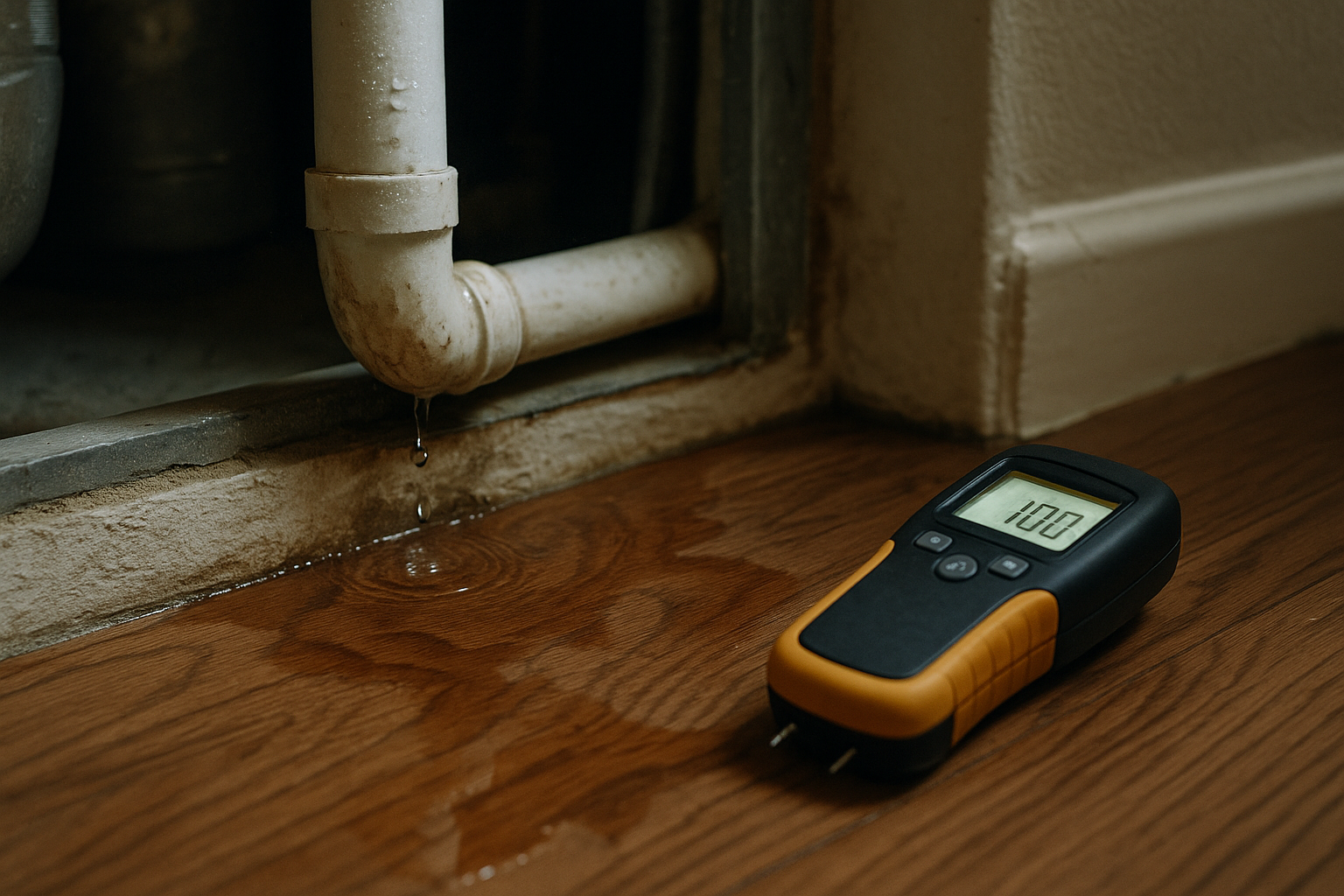
If your AC has been running nonstop the last couple of days, go check your drain line right now — I’ll wait. With the heat index hitting 110° today and tomorrow across North Texas, this is exactly the kind of stretch that turns a small, invisible drip into a soaked ceiling or a warped wall in Krugerville homes.
I know that sounds dramatic for something as unglamorous as air conditioner condensation. But this is one of those quiet water damage causes that catches people off guard every single summer, and this week’s heat is setting up the perfect conditions for it.
Why extreme heat causes AC condensation backup
Your air conditioner isn’t just cooling air — it’s pulling moisture out of it, especially on days like today when the outdoor heat index is brutal and your unit is working overtime. All that moisture collects as condensation and is supposed to drain out through a small PVC pipe, usually running from the indoor air handler out to the side of your house.
When your AC runs harder and longer (which it will, at 110°), it produces more condensation than usual. If that drain line has even a partial clog — algae, dirt, a bit of sludge — the extra volume can be enough to back the water up and overflow the drain pan instead of draining outside.
From there, that water doesn’t stay put. It runs into your attic insulation, down through your ceiling drywall, or behind the walls near your air handler — often for hours or days before anyone notices a stain or a soft spot in the ceiling.
A quick check that takes two minutes
Here’s what I’d do in my own house today:
- Find your indoor air handler (often in a closet, attic, or garage) and look at the drain pan underneath it — is there standing water?
- Go outside and find where the condensate drain line exits the house (usually a small white PVC pipe near the unit). Is it actively dripping? A slow, steady drip during peak heat is normal. No drip at all, when your AC has clearly been running, can be a sign of a clog.
- Check the ceiling below or near your air handler for any new discoloration, sagging, or a musty smell.
- If your system has a secondary drain pan with a float switch, make sure nothing’s tripped it — some units are built to shut the AC off before it overflows, which is a good problem to have.
If you see standing water, active dripping indoors, or any ceiling staining — that’s not a “wait and see” situation. Water sitting in a ceiling cavity in 110° heat and humidity is exactly the environment mold loves, and the longer it sits, the more it spreads into places you can’t see from the room.
What happens if it’s already gotten past “just noticed it”
If you’re past the two-minute check and you’ve already got wet drywall, a stained ceiling, or water damage spreading, the first priority isn’t guessing — it’s stopping the water, drying the structure properly, and figuring out how far it traveled. That’s where a moisture meter and thermal camera earn their keep, because AC leaks love to hide behind walls and above ceilings where you’d never think to look.
I won’t tell you it’s no big deal, and I won’t tell you it’s the end of the world either. Most AC condensation damage, caught early, is very manageable. Caught late, it gets expensive fast — that’s just the honest truth of it.
We’re right here in North Texas
Merlene Mitigation is based in Pilot Point, and Josh personally handles every water damage call and inspection across our North Texas service area, Krugerville included. No call center, no subcontracted stranger showing up at your door — just one accountable person who’ll tell you straight what you’re dealing with.
Right now, through July 29th, we’re offering free water damage inspections — so if you found something during your two-minute check today, or you’re just not sure, there’s no cost to finding out.
Give us a call. We’d rather look at it today and tell you it’s nothing than have you find out the hard way in a month.
-Ally
Leave a Reply