
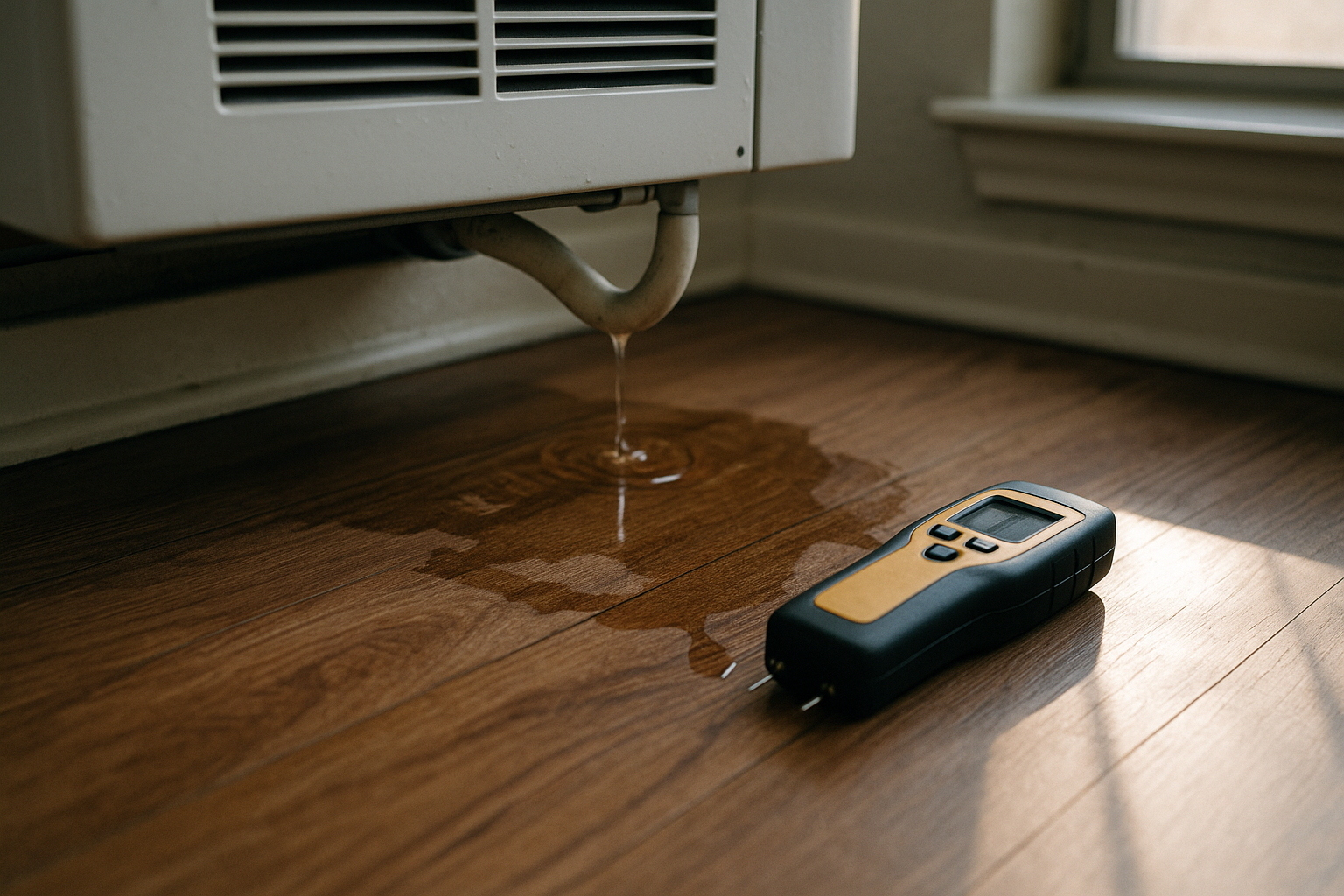
If you stepped outside in Krugerville today, you already know: that’s not just “hot,” that’s a 107° heat index kind of hot. Your AC unit knows it too — and it’s working harder than it has all year to keep up. That extra strain is exactly why we tend to see a spike in calls about water where water shouldn’t be, right around the base of the air handler or dripping from a ceiling vent.
Here’s the good news: an AC leak is one of the most preventable water problems there is, if you catch it early. Let’s talk about why it’s happening right now, and what to do about it before it turns into something bigger.
Why heat advisories cause AC leaks
Your air conditioner doesn’t just cool the air — it pulls moisture out of it, too. That condensation has to go somewhere, and normally it drains quietly out through a small PVC line to the outside.
On a day like today, your system is running nearly nonstop to keep the house comfortable. More runtime means more condensation, which means more water moving through that drain line. If there’s even a little bit of algae, dust, or debris built up in there — which is common, especially if the line hasn’t been cleaned in a while — this is the day it finally clogs.
Once it clogs, that water has nowhere to go but back up and out. Most systems have a drain pan underneath as a backup, but pans overflow, and float switches (if the unit even has one) don’t always catch it in time. That’s when you start seeing a wet spot on the ceiling below the attic unit, or water pooling near the indoor air handler.
What to check right now
- The drain line termination — usually a PVC pipe outside near the condenser, or one that ends near your water heater. Is it dripping steadily? A slow drip is normal on a day like today. A stream, or no flow at all, is worth a closer look.
- The attic access, if your air handler is up there. Look for staining on the ceiling below it, or a damp spot near the unit itself.
- Around the indoor unit — closet, utility room, wherever it lives. Standing water in the drain pan means the primary line is clogged and the backup is catching it.
- Ceiling stains or a musty smell in rooms below an attic unit — these show up before you’d notice water dripping.
If you find standing water or a clog, this is a good moment to call your HVAC technician for a proper repair — that part’s really their trade, not ours. But if water has already made it into drywall, insulation, flooring, or a ceiling, that’s where we come in.
Why the wet stuff matters more than it looks like it should
A little AC condensation on the ceiling doesn’t look like much. But drywall and insulation hold onto moisture, and North Texas humidity doesn’t help it dry out on its own. Give it a few days in this heat, closed up in a warm attic, and you’ve got the right conditions for mold to start — quietly, out of sight, right where you can’t see it.
That’s the thing about water damage that surfaces don’t tell you: what looks dry on top can still be wet underneath. If a leak’s been going on for a while, or you’re not sure how long that ceiling stain has been there, it’s worth having it checked properly rather than guessing.
If it’s already gotten past “small drip”
If you’re looking at a sagging ceiling, a soaked carpet, or water actively coming through a light fixture — stop guessing and call someone. The first hours matter: getting the water out, drying the area properly, and catching it before it spreads is what keeps a bad day from becoming a bad month.
I can’t promise it won’t be disruptive — pulling out wet materials and running drying equipment never is. But I can promise to make it as least disruptive as possible, and to walk you through exactly what’s happening and why, every step of the way.
We’re offering free inspections this week
With this heat advisory pushing so many systems to their limit, we’re offering free water damage inspections through July 29th for North Texas homeowners — Krugerville included. No pressure, no upsell. Just a straight answer on whether that ceiling stain or damp spot is something to watch, or something to act on now.
Merlene Mitigation is a small, local, owner-operated outfit based just down the road in Pilot Point. When you call, you get me or my husband — not a call center, not a stranger in a branded truck. Lower overhead means fair prices, and one accountable person means nothing gets lost between “we found a problem” and “here’s how we fix it.”
If today’s heat has you eyeing a wet spot with suspicion, give us a call. We’d rather look at ten false alarms than have one homeowner wait too long on the real thing.
-Ally
Leave a Reply