
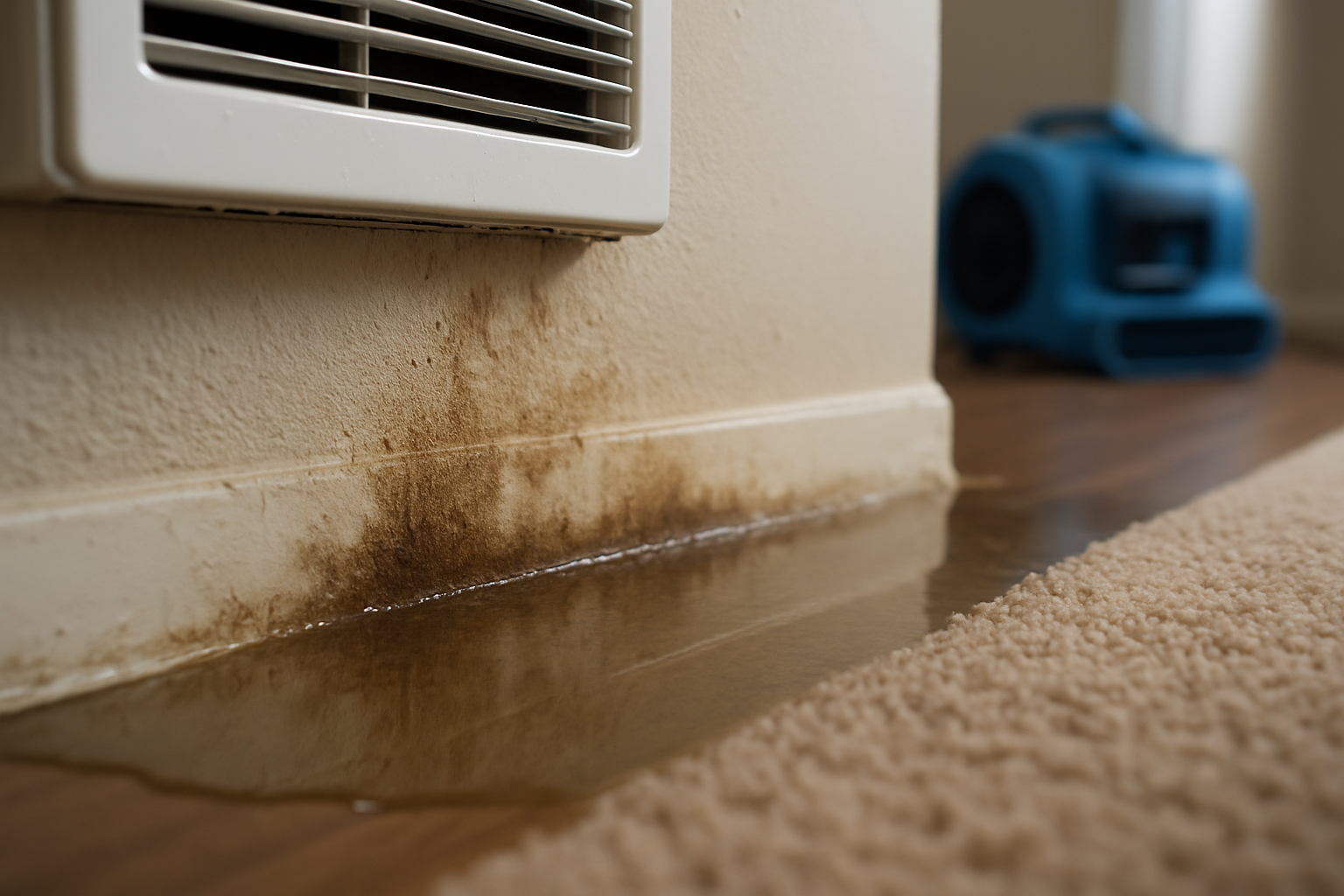
If your AC has been running nonstop today, here’s something worth checking before you head to bed tonight: the drip pan under your indoor unit, and the drain line running out of it. With a heat index near 114°F across Denton County today, air conditioners are working harder than they’re built to work — and that extra strain is exactly what causes condensation drain lines to clog, crack, or back up. When that happens, water doesn’t stay contained. It finds your ceiling, your closet, your attic insulation, or the wall behind your unit.
This is a quiet kind of water damage. No storm, no leak you can hear — just a slow overflow that can soak drywall and insulation for hours before anyone notices. Let’s talk about what to watch for tonight, and what to do if you catch it early.
Why extreme heat causes AC drain line failure
Your air conditioner pulls moisture out of the air as it cools your home — that water is supposed to drain out through a small condensate line, usually PVC pipe, into a drain or outside your house. On a normal day, that’s a manageable amount of water.
On a day like today, your system runs longer and harder, which means it’s pulling more moisture out of the air than usual — sometimes gallons more over a 24-hour stretch. If that drain line has any buildup of algae, dirt, or debris (which most lines do, eventually), the extra volume is often what pushes it from “slow trickle” to “fully clogged.” Once it’s clogged, the water has nowhere to go but back up — into the drip pan, and eventually over the edge.
Warning signs to check tonight
- A water stain or soft spot on the ceiling below or near your attic AC unit.
- Musty smell near a closet or utility room where your indoor unit lives.
- Visible water or standing moisture in the drip pan under the unit.
- Your AC suddenly stops cooling — many systems have a safety float switch that shuts the unit off when the pan fills, which is actually a good sign your system is protecting your house. Don’t just reset it and move on; find out why it filled up.
- Water near the outdoor condensation drain line
What you can safely do right now
A few things are genuinely fine to check yourself, no plumber required:
- Look at the drip pan and drain line for standing water or visible clogs.
- If you know where your condensate line’s cleanout is, a wet/dry vac on the outside opening can sometimes pull a clog free.
- Keep a towel or shallow container under the unit temporarily if you spot dripping, just to protect the floor while you sort out the cause.
If none of that resolves it, or you’re not sure where to even look, that’s a good moment to call an HVAC tech rather than guess. I’d rather be honest with you about that than pretend every fix is a DIY job — some are, some aren’t, and a backed-up line deep in the line set usually needs the right tools.
If water’s already gotten into drywall or insulation
This is where I want to be straight with you: once water has soaked into drywall, insulation, or wood framing, it doesn’t matter how hot and dry the air outside is — that moisture isn’t evaporating on its own fast enough to prevent mold growth or structural damage underneath. “It looks dry” and “it is dry” are two different things, and the difference is exactly where hidden problems start.
If you’re looking at a stained ceiling or a damp closet floor tonight, the sooner it gets properly dried — with real moisture readings, not just a guess — the smaller and cheaper the problem stays.
We’re here if you need us
I can’t promise a night like tonight won’t be stressful — but I can promise that if water’s gotten into your home, we’ll treat it like it’s ours: honest about what’s actually needed, nothing more. Josh handles every water damage call personally, so you’re not getting handed off to a stranger, and our lower overhead means fair pricing without cutting corners.
If you’re in Pilot Point, Denton, or anywhere in North Texas and you’re staring at a wet ceiling tonight, give us a call. We’d rather help you catch it early than have it wait until morning.
-Ally
Leave a Reply