
Tag: tioga tx

  • Water Damage Cleanup in Tioga, TX: First 24 Hours

    Water Damage Cleanup in Tioga, TX: First 24 Hours

    It’s 11pm, the washing machine hose let go, and water is spreading across your kitchen floor faster than you can grab towels. Or maybe it’s a slow leak you just noticed behind the water heater, and you’re not sure if it’s an emergency or something that can wait until morning.

    Either way, what you do in the first 24 hours matters more than almost anything else that happens after. That’s true whether you’re in Tioga, Pilot Point, or anywhere else in North Texas. I want to walk you through what actually needs to happen, in order, so you know what to expect — whether you call us or not.

    Step One: Stop the Water, Then Stabilize

    Before anything else, the source has to be shut off. If it’s a supply line or appliance, that usually means the water shutoff valve to the house or fixture. If it’s coming in from outside — a roof leak or foundation issue during a storm — that’s a different problem, and safety comes first. Never wade into standing water near outlets or electrical panels.

    Once the water’s stopped, day one is about stabilizing the situation, not fixing everything. That means:

    • Extracting standing water — the faster this happens, the less it has a chance to soak into flooring, drywall, and subfloor.
    • Applying antimicrobial treatment to affected surfaces, to get ahead of bacterial and mold growth before it starts.
    • Setting drying equipment — commercial air movers and dehumidifiers, not the box fan from the garage — to begin pulling moisture out of the structure itself.

    That’s it for day one. We’re not trying to make every decision about repairs yet. We’re just trying to stop the damage from getting worse while everyone — you, your insurance company if you’re filing a claim, and whoever’s doing the drying — gets a chance to catch up.

    Why We Reassess in 24–48 Hours, Not Immediately

    Water is sneaky. It looks like it’s just on the surface, but it wicks into places you can’t see — under baseboards, inside wall cavities, beneath flooring. That’s why a full, honest scope of the damage usually waits until 24 to 48 hours in. Moisture meters and thermal imaging can show what’s actually wet versus what just looks dry, and that picture gets clearer once the initial extraction and drying have had a little time to work.

    This isn’t us dragging our feet. It’s the opposite — it’s how you avoid tearing out more than necessary, or missing something that turns into a bigger problem in a month.

    About Mold — What’s True and What’s Hype

    Mold needs moisture to grow, and it doesn’t take long — under the right conditions, it can start within 24 to 48 hours. The best mold prevention after water damage isn’t a spray or a treatment. It’s fast, thorough drying. That’s the whole game.

    I’ll be straight with you: I’m not a licensed Texas mold assessment consultant, and if you’re dealing with a significant mold concern, that’s a separate, licensed professional’s job. What I can do is help you understand how moisture and mold are connected, get the structure dry as quickly as possible, and point you toward the right people if it goes beyond that.

    Yes, the Equipment Is Loud — Here’s Why It Stays On

    Once drying equipment is running, I know it’s disruptive. Air movers and dehumidifiers aren’t quiet, and having them running around the clock in your living room is nobody’s idea of fun. My honest advice: get out of the house when you can, put music on, choose your sanity.

    What I won’t ever tell you is that it’s okay to turn them off early. Cutting drying time short is exactly how a contained water problem turns into a mold problem down the line, and that’s a much bigger headache than a few loud days.

    If Something’s Happening Right Now

    If you’re dealing with water damage in Tioga or anywhere in North Texas today, call or text me directly. I’m typically on-site within the hour for emergencies, and if I’m already with another customer, I’ll call you back with a real ETA so you’re not left wondering. Merlene Mitigation is a small, local operation — it’s me handling your inspection and your job, not a call center routing you to a stranger. Low overhead means fair pricing, and one accountable person means nothing gets lost between “who do I even call” and “it’s handled.”

    If nothing’s actively happening at your place right now but you’d rather be ready than caught off guard, I put together a free guide called The First 24 Hours After Water Damage. It walks through exactly what to do, in order, before help arrives. Worth having on hand before you ever need it.

    -Ally

  • AC Condensation Leaks in Tioga, TX: What to Check Now

    AC Condensation Leaks in Tioga, TX: What to Check Now

    If your AC has been running nonstop today, you’re not imagining it. With the heat index hitting 106° across North Texas, air conditioners in Tioga and the surrounding Pilot Point area are working harder than they have all year — and hardworking AC units produce a lot more condensation than usual. That extra moisture has to go somewhere, and when the drain line can’t keep up, it goes into your home.

    Here’s the part that catches people off guard: an overflowing AC condensate line doesn’t announce itself. It drips quietly into a ceiling, behind a wall, or under a closet floor for hours — sometimes days — before anyone notices a stain or a smell. By the time it’s visible, the water’s usually already gone further than it looks.

    Why Extreme Heat Makes This Worse

    On a normal day, your AC cycles on and off, and the condensate drain has time to keep pace. During a heat advisory like today’s, the system runs almost continuously to keep up with the temperature outside. More run time means more condensation, and a drain line or pan that was just barely managing before can tip over into an overflow now.

    This is exactly the kind of summer AC failure at 106 degrees we watch for this time of year — not because the unit is broken, but because it’s being pushed to its limit for hours on end.

    What to Check Right Now (Takes 5 Minutes)

    • The drain pan under your indoor unit — usually in the attic or a closet. Any standing water or rust is a warning sign.
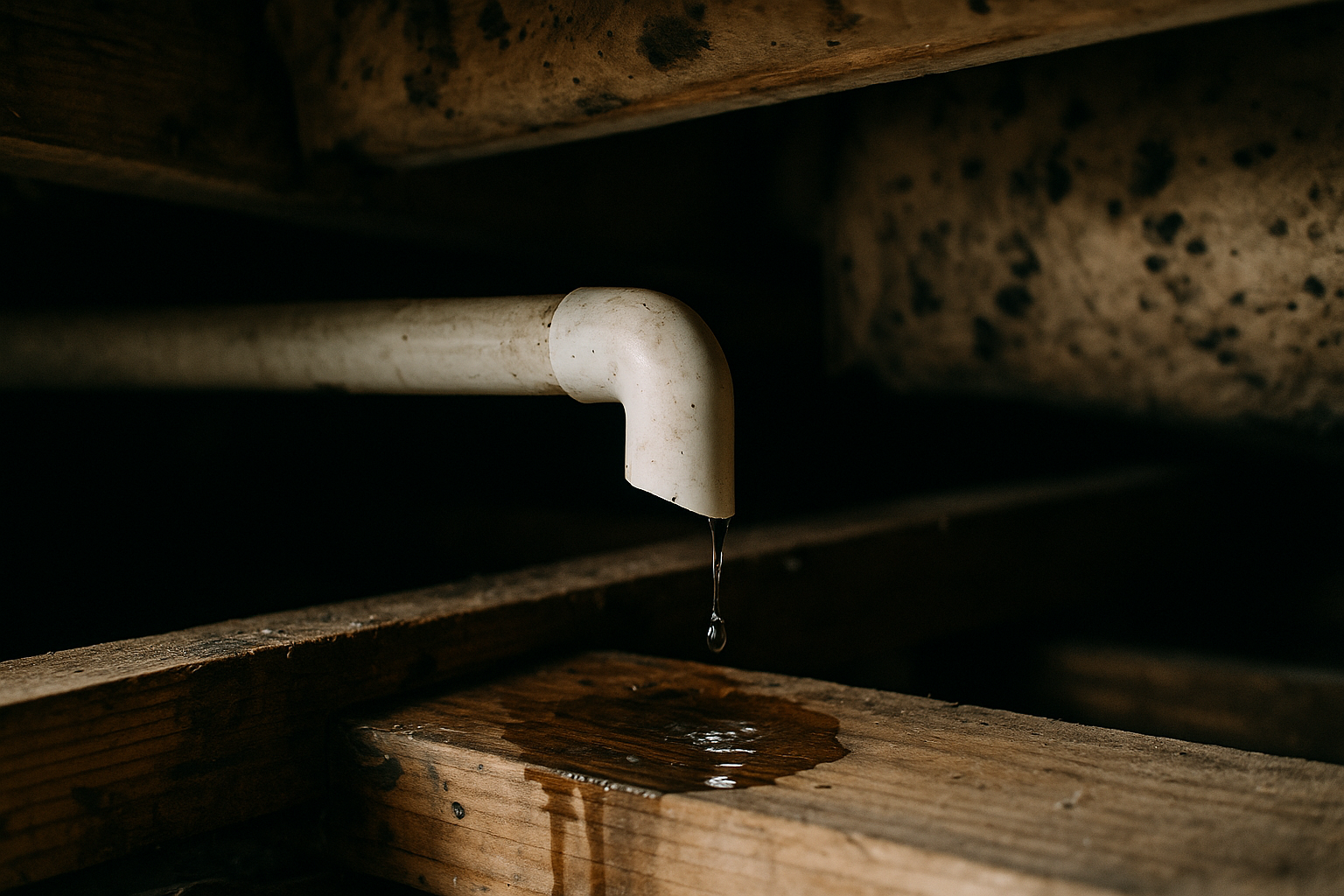
    • The PVC drain line running outside your house — it should be dripping steadily, not gushing, not dry and clogged.
    • Ceilings and walls near your indoor unit — look for soft spots, discoloration, or a musty smell.
    • The float switch, if your system has one — it’s supposed to shut the AC off before an overflow happens, but it can fail or get bypassed.
    • Baseboards and flooring near closets or attic access points, especially if your unit is up there.

    If you find water, don’t just wipe it up and move on. Standing water you can see usually means there’s more you can’t — soaked insulation, wet drywall, or moisture already working its way into a subfloor. This is where hidden water damage around the Pilot Point area tends to start small and quietly turn into something expensive.

    Why “It’s Probably Fine” Is the Risky Answer

    I understand the instinct to towel it off and hope tomorrow’s cooler. But drywall and wood don’t dry on their own the way a countertop does. Trapped moisture behind a wall can sit there for weeks, and that’s exactly the environment mold needs to get started. What starts as a small, cheap fix — drying out a small area, maybe replacing a bit of drywall — can turn into a much bigger job if it’s left to soak in unnoticed.

    If you do find an active leak, the right first move is simple: get the AC unit’s water source stopped (a technician can do that) and get the wet materials drying as soon as possible. Once drying equipment is in place, it needs to run its full course — turning it off early to cut the noise or get some quiet risks the moisture creeping back in, which is the last thing you want after doing the hard part right.

    You’re Not Alone in the Heat

    Days like today are tough on every AC system in North Texas, and you’re far from the only one dealing with it. If you find water damage from AC condensation in Tioga or anywhere nearby, I want you to know there’s a real, local option — not a call center, not a franchise passing you between departments. Josh personally handles inspections and water damage response, and he’s usually on-site within the hour for emergencies. Lower overhead means fair pricing, and one accountable person means nothing gets lost between “who do I call” and “who actually shows up.”

    If you’re dealing with water right now, call or text Josh — texting works great if you’re mid-crisis and can’t talk. And if today’s just a scare and everything checked out fine, that’s a good moment to grab our free guide, “The First 24 Hours After Water Damage,” so you know exactly what to do if a day like this ever turns into something more.

    -Ally

  • Water Damage Restoration in Tioga, TX: First 24 Hours

    The wind picks up, the sky turns that particular shade of green-gray, and somewhere in the back of your mind you’re already thinking about the ceiling in the back bedroom that’s never quite convinced you it’s watertight. If you live in Tioga, you know this feeling. August storms roll through North Texas fast and hard, and by the time they pass, some of us are standing in a puddle wondering what to do next.

    If that’s you right now, here’s the good news: what you do in the next 24 hours matters more than almost anything else in the whole process. Get this part right, and you set yourself up for a much smoother recovery. So let’s walk through it together, step by step.

    Why the First 24 Hours Matter So Much

    Water doesn’t wait. The longer it sits in your walls, floors, and furniture, the more it spreads, and the more it costs to fix. What starts as a wet baseboard on day one can turn into swollen drywall, warped flooring, and mold risk by day three or four.

    That’s why, when it comes to water damage cleanup in Tioga TX, the first day is really about one thing: stabilizing the situation. Not fixing everything, not making every decision about your home right away — just stopping the damage from getting worse while everyone, including your insurance company, catches up.

    Your First 24 Hours: A Simple Action Plan

    1. Make sure everyone’s safe first

    Before anything else — if there’s standing water anywhere near an electrical outlet, panel, or appliance, stay out and shut off power to that area if you can do so safely. Water and electricity are a genuinely dangerous combination. This isn’t the moment to be a hero.

    2. Stop the source, if you can

    If it’s a roof leak from storm damage, you likely can’t stop it until the rain lets up or a tarp goes on. If it’s a broken pipe or an appliance issue that got a boost from the storm, shutting off your home’s main water valve can save you from a much bigger mess.

    3. Get the water moving out

    Towels, a wet/dry shop vac, mop buckets — whatever you’ve got. Getting standing water out of the house early genuinely helps, even before a professional shows up. Every gallon that doesn’t sit and soak is one less gallon working its way into your subfloor.

    4. Move what you can

    Furniture, rugs, boxes, anything on the floor in the affected area — get it up and out if you’re able. Wood and upholstered furniture can wick up water fast and start to warp or mildew within a day.

    5. Take photos before you touch anything else

    Your insurance adjuster is going to want to see what things looked like right after the storm. A few minutes with your phone now can save you a headache later.

    6. Call a professional

    This is the point where emergency water damage in Tioga and the surrounding North Texas area really needs a trained eye. A professional can tell you what’s actually wet — not just what looks wet — using tools like moisture meters and thermal imaging. Surfaces dry fast. What’s underneath them doesn’t always follow suit, and that’s where the real risk of mold and structural damage lives.

    What Happens Next: Stabilize, Then Reassess

    Here’s how I think about it, and how Josh approaches every storm water damage call: day one is about stabilizing. That means extracting the water, applying antimicrobial treatment to guard against mold, and setting up commercial-grade drying equipment to start pulling moisture out of your structure.

    Then, within 24 to 48 hours, comes a full reassessment — a more complete picture of what’s really going on, once the immediate crisis is handled and everyone can think clearly. That includes insurance. This two-step rhythm isn’t about slowing things down. It’s about making sure nothing gets missed and no decision gets rushed.

    I’ll be honest with you about one part of this that nobody loves: the drying equipment is loud, and it runs around the clock for a few days. I can’t promise it won’t be disruptive. What I can promise is that it’ll be as least disruptive as possible, and that turning it off early to get some quiet, tempting as that sounds, risks the very damage you’re trying to avoid. Put on a podcast, get out of the house for a few hours if you need to — but let the equipment do its job.

    You’re Not Alone in This

    Merlene Mitigation is based right here in Pilot Point, and Josh personally handles every water damage inspection and job — no call center, no rotating crew of strangers, just one accountable person who treats your home like it matters. Lower overhead means fair pricing, and being local means a fast response when a storm hits close to home.

    If your Tioga home has water damage right now, call or text Josh — he’d rather talk you through it over the phone than have you guess.

    And if today isn’t an emergency but you’d like to be ready before one ever happens, we put together a free guide called The First 24 Hours After Water Damage. It walks through everything above in more detail, so it’s already saved somewhere you can find it when you actually need it.

    -Ally

  • AC Condensation Leaks in Tioga, TX: Prevent Water Damage

    AC Condensation Leaks in Tioga, TX: Prevent Water Damage

    If you’ve stepped outside in Tioga this week, you already know: the heat index is flirting with 99°, and it’s not letting up. Your air conditioner is working harder than it has all year — which means one small, often-overlooked part of your AC system is working harder too. And when it fails, it doesn’t announce itself with a loud bang. It just quietly drips, day after day, usually somewhere you can’t see.

    That part is your condensate drain line, and this time of year, it’s one of the most common causes of water damage we see in North Texas homes.

    Why extreme heat makes condensation overflow more likely

    Your AC doesn’t just cool air — it pulls moisture out of it. All that humidity has to go somewhere, and normally it drains harmlessly outside through a small PVC line. But the harder your unit runs (and in 99° heat, it’s running almost constantly), the more condensation it produces.

    If that drain line is even partially clogged — with algae, dust, or debris, which is extremely common — the extra volume can push it over the edge. Instead of draining outside, the water backs up into the drain pan. And if the pan is full, old, or cracked, it starts finding its way into your attic, your ceiling, or down inside a wall cavity.

    That’s the part that worries us most: this kind of leak is often completely invisible until it isn’t. A stain on the ceiling, a musty smell in a closet, or a soft spot in the drywall can mean water’s been quietly working behind the scenes for days or weeks.

    What to check today, while it’s still manageable

    You don’t need special tools or training to do a basic check. A few minutes now could save you a much bigger headache later.

    • Look at the drain line outside. Find the PVC pipe near your outdoor unit (or coming out near your indoor unit). Is water actively dripping from it? A steady drip is normal when the AC is running hard. No drip at all could mean a clog upstream.
    • Check the emergency shut-off switch or float switch. Many systems have a small pan under the indoor unit with a float switch designed to shut the AC off if water rises too high. If your AC has randomly stopped cooling, this could be why — and it’s actually doing its job.
    • Look for staining or sagging near your attic access, closet ceilings, or around vents. Especially if your indoor unit is in the attic, this is often the first visible sign.
    • Feel around interior walls near AC lines for soft spots or a faint musty smell. Hidden moisture behind drywall doesn’t always show up as a visible stain right away.

    If you find active water where it shouldn’t be, the priority is simple: get the moisture stopped and get air moving on the area as soon as possible. Don’t wait to see if it dries on its own — surfaces can look dry within a day while the structure underneath stays wet for much longer, and that’s exactly the environment mold needs to get started.

    Why “it’s probably fine” is the wrong bet right now

    We understand the instinct to wait and see. Nobody wants to make a big deal out of a small drip. But with heat this extreme, small drips add up fast, and the cost difference between “caught it early” and “found it three weeks later” is significant — both in dollars and in disruption to your home.

    This is exactly the kind of thing we’d rather you catch on day one than day twenty-one.

    We’re here, and we’re local

    Merlene Mitigation is based right up the road in Pilot Point, and we serve Tioga and the surrounding communities. If you’ve found water where you shouldn’t have, or you’re just not sure what you’re looking at, we offer a free water damage inspection through August 6th — no pressure, no obligation, just an honest look and a straight answer about what’s going on.

    You can call or text Josh directly — texting works great if that’s easier for you. When it’s your home on the line, you deserve someone who’ll tell you the truth, whether that means a same-day fix or just peace of mind that everything’s fine.

    And if nothing’s wrong today but you want to be ready in case something ever does go wrong, we put together a free guide called The First 24 Hours After Water Damage. It walks through exactly what to do first, so you’re not scrambling to figure it out in the moment.

    Stay cool out there, Tioga.

    -Ally

  • AC Condensation Leaks in Tioga, TX: Hidden Water Damage Risk

    AC Condensation Leaks in Tioga, TX: Hidden Water Damage Risk

    If your AC has been running nearly nonstop this week, you’re not imagining it. With the heat index hitting 110° across North Texas, every system in Tioga is working harder than it was built to handle for weeks at a time. That’s tough on your unit, and it’s tough on something people rarely think about: the condensation drain line quietly carrying water away from your indoor coil, every single hour, all day long.

    Here’s the part that catches folks off guard. When that line clogs or backs up, you often don’t see it happening. No dramatic leak, no puddle in the middle of the floor. Just water finding its way into a wall cavity, a ceiling void, or a crawl space, day after day, while your house looks completely normal from the inside.

    Why This Happens So Much More in Extreme Heat

    Your AC’s job is to pull humidity out of the air, and that moisture has to go somewhere. Normally it drips into a pan and drains outside through a small condensate line. But when a system runs longer and harder, like it has to in a 110° heat index, it pulls more moisture than usual, and the drain works overtime right along with it.

    Algae, dust, and debris build up inside that line over time no matter what, but heavy runtime speeds the whole process up. A line that’s been fine for months can back up in a matter of days when the system barely gets a break.

    Where the Water Actually Goes

    This is the part that turns an AC hiccup into real water damage. Depending on how your ductwork and lines are routed, a backed-up drain can send water into:

    • The wall cavity behind or below your indoor air handler
    • Ceiling drywall, if your unit is in an attic
    • Crawl space framing and insulation
    • Subfloor around a closet or utility space

    None of those places are somewhere you look every day. That’s exactly why this kind of water damage in Tioga homes tends to get discovered late, usually when a stain finally shows up on a ceiling or a musty smell starts creeping into a room.

    Early Signs Worth Checking This Week

    You don’t need any special equipment to catch this early. A few minutes of looking is usually enough:

    • A musty smell near a closet, utility room, or hallway that wasn’t there before
    • Soft or discolored drywall near your indoor unit
    • Visible water or standing moisture in the drain pan itself
    • Your AC’s overflow safety switch shutting the system off (that switch is doing its job, so don’t just reset it and ignore it)
    • A ceiling stain that seems to appear out of nowhere

    If you catch any of these now, while the heat index is still up, you’ve got a real chance to deal with it before it turns into something bigger. Wet wood and wet drywall don’t dry on their own in a Texas summer with the humidity we’ve got, and the longer that moisture sits inside a wall or under a house, the more it invites the kind of hidden damage that’s expensive to fix and even harder to catch after the fact.

    Why “It Looks Dry” Isn’t the Same as “It Is Dry”

    This is something I say a lot, and it’s worth repeating here. Surfaces dry fast. The structure underneath, the framing, the subfloor, the insulation, holds onto moisture a lot longer than you’d guess just by touching drywall or looking at a stain. That’s where real damage and mold risk actually live, and it’s why a quick visual check is a good first step, not a final answer.

    If You Find Something

    If you spot any of this, the honest first move is to shut off your AC’s power at the breaker or thermostat and get eyes on it, rather than let it keep draining into the same spot. Beyond that, this is exactly the kind of thing worth having a second set of eyes on, especially with how much moisture North Texas air holds onto right now.

    Right now, through July 29th, we’re offering free water damage inspections for homeowners in Tioga and the surrounding area. No pressure, no sales pitch, just an honest look at what’s actually going on so you know where you stand.

    And if nothing’s going on today but you’d rather be ready than caught off guard, I put together a free guide called The First 24 Hours After Water Damage. It walks through exactly what to do first if you ever do find water where it shouldn’t be.

    Merlene Mitigation is based right here in Pilot Point, and Josh personally handles every inspection and every job, no crew of strangers, no big franchise overhead. That keeps things honest and keeps prices fair. If you’re in Tioga or anywhere nearby and want a second opinion on what you’re seeing, give us a call. We’re glad to help, heat wave or not.

    -Ally