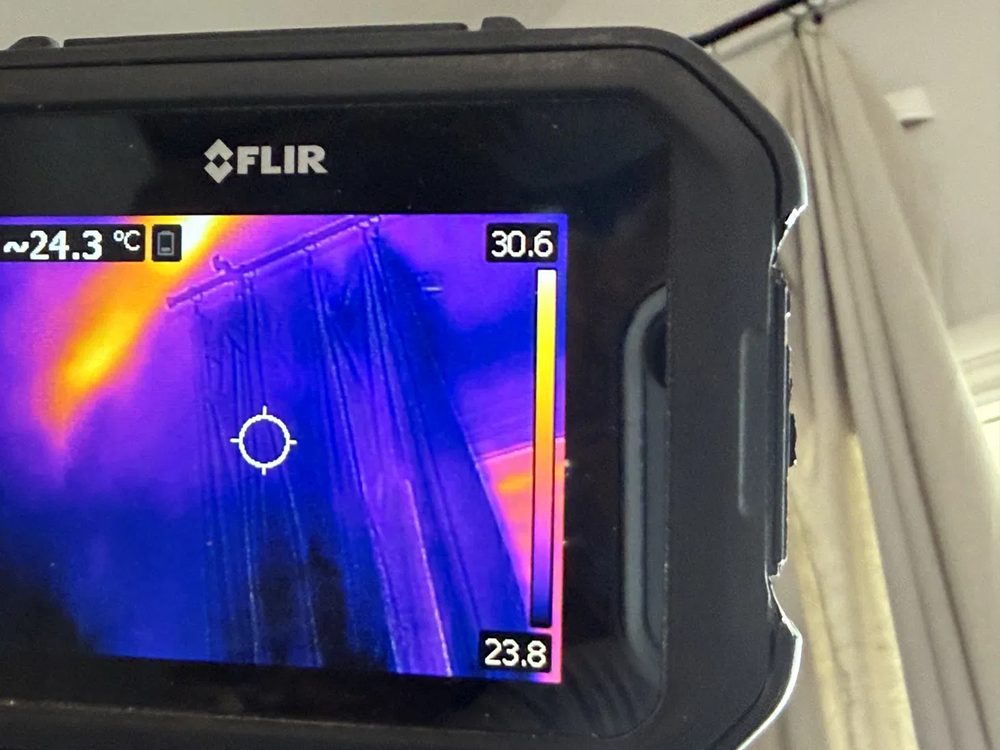
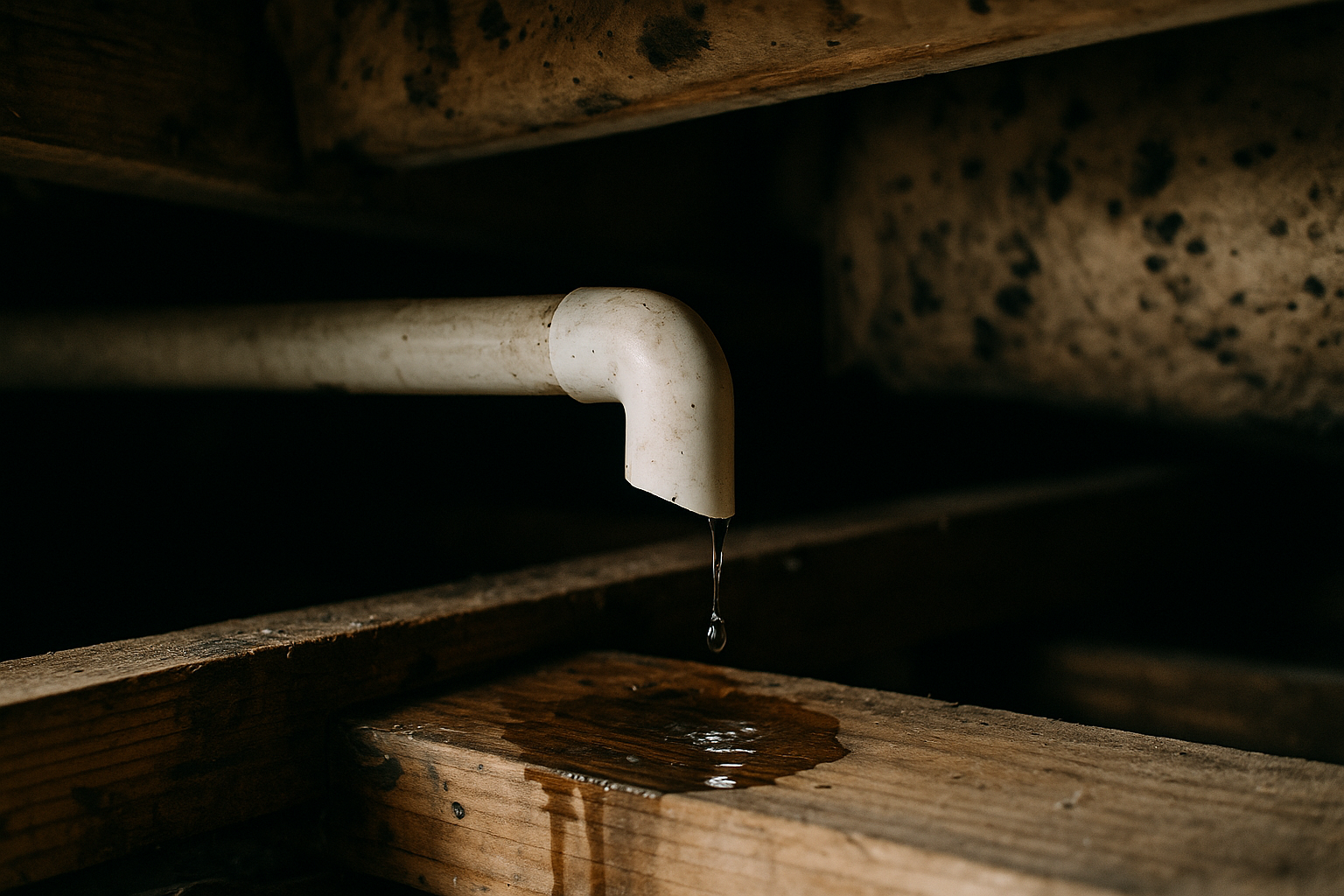
If your AC has been running nearly nonstop this week, you’re not imagining it. With the heat index hitting 110° across North Texas, every system in Tioga is working harder than it was built to handle for weeks at a time. That’s tough on your unit, and it’s tough on something people rarely think about: the condensation drain line quietly carrying water away from your indoor coil, every single hour, all day long.
Here’s the part that catches folks off guard. When that line clogs or backs up, you often don’t see it happening. No dramatic leak, no puddle in the middle of the floor. Just water finding its way into a wall cavity, a ceiling void, or a crawl space, day after day, while your house looks completely normal from the inside.
Why This Happens So Much More in Extreme Heat
Your AC’s job is to pull humidity out of the air, and that moisture has to go somewhere. Normally it drips into a pan and drains outside through a small condensate line. But when a system runs longer and harder, like it has to in a 110° heat index, it pulls more moisture than usual, and the drain works overtime right along with it.
Algae, dust, and debris build up inside that line over time no matter what, but heavy runtime speeds the whole process up. A line that’s been fine for months can back up in a matter of days when the system barely gets a break.
Where the Water Actually Goes
This is the part that turns an AC hiccup into real water damage. Depending on how your ductwork and lines are routed, a backed-up drain can send water into:
- The wall cavity behind or below your indoor air handler
- Ceiling drywall, if your unit is in an attic
- Crawl space framing and insulation
- Subfloor around a closet or utility space
None of those places are somewhere you look every day. That’s exactly why this kind of water damage in Tioga homes tends to get discovered late, usually when a stain finally shows up on a ceiling or a musty smell starts creeping into a room.
Early Signs Worth Checking This Week
You don’t need any special equipment to catch this early. A few minutes of looking is usually enough:
- A musty smell near a closet, utility room, or hallway that wasn’t there before
- Soft or discolored drywall near your indoor unit
- Visible water or standing moisture in the drain pan itself
- Your AC’s overflow safety switch shutting the system off (that switch is doing its job, so don’t just reset it and ignore it)
- A ceiling stain that seems to appear out of nowhere
If you catch any of these now, while the heat index is still up, you’ve got a real chance to deal with it before it turns into something bigger. Wet wood and wet drywall don’t dry on their own in a Texas summer with the humidity we’ve got, and the longer that moisture sits inside a wall or under a house, the more it invites the kind of hidden damage that’s expensive to fix and even harder to catch after the fact.
Why “It Looks Dry” Isn’t the Same as “It Is Dry”
This is something I say a lot, and it’s worth repeating here. Surfaces dry fast. The structure underneath, the framing, the subfloor, the insulation, holds onto moisture a lot longer than you’d guess just by touching drywall or looking at a stain. That’s where real damage and mold risk actually live, and it’s why a quick visual check is a good first step, not a final answer.
If You Find Something
If you spot any of this, the honest first move is to shut off your AC’s power at the breaker or thermostat and get eyes on it, rather than let it keep draining into the same spot. Beyond that, this is exactly the kind of thing worth having a second set of eyes on, especially with how much moisture North Texas air holds onto right now.
Right now, through July 29th, we’re offering free water damage inspections for homeowners in Tioga and the surrounding area. No pressure, no sales pitch, just an honest look at what’s actually going on so you know where you stand.
And if nothing’s going on today but you’d rather be ready than caught off guard, I put together a free guide called The First 24 Hours After Water Damage. It walks through exactly what to do first if you ever do find water where it shouldn’t be.
Merlene Mitigation is based right here in Pilot Point, and Josh personally handles every inspection and every job, no crew of strangers, no big franchise overhead. That keeps things honest and keeps prices fair. If you’re in Tioga or anywhere nearby and want a second opinion on what you’re seeing, give us a call. We’re glad to help, heat wave or not.
-Ally