
Tag: cross roads tx

  • AC Condensation Leaks in Cross Roads, TX: Heat Warning Checklist

    If you live in Cross Roads and your AC has been running nonstop the last day or two, here’s something worth checking before you head to bed tonight: the little drain line tucked behind or under your air handler. With the Extreme Heat Warning in effect and heat index values climbing to 108–109°F, that small line is doing the hardest work in your whole house right now, and it’s exactly the kind of thing that fails quietly, at 2am, while everyone’s asleep.

    I want to walk you through why that happens and what you can actually do about it tonight, no tools or expertise required.

    Why extreme heat is brutal on your AC’s drain line

    Your air conditioner doesn’t just cool your house, it pulls moisture out of the air too. On a normal summer day, that condensation drips into a pan, runs down a small PVC line, and exits outside without you ever thinking about it.

    But on a day like today, with the system running almost continuously to keep up with 108-plus heat index values, your AC is pulling far more moisture than usual, for far longer stretches. That means more condensation, more volume through that drain line, and more opportunity for a clog, a crack, or a slow leak to turn into standing water on your ceiling or in your closet.

    This is one of the most common causes of water damage we see in North Texas during heat warnings like this one, and it’s almost always preventable if you catch it early.

    Your extreme heat AC checklist tonight

    • Check the drain pan. If your unit is in the attic or a closet, look underneath it for any standing water or dampness. Even a small amount is worth taking seriously.
    • Look for a wet or musty smell near vents or the attic access. Your nose will often catch a slow leak before your eyes do.
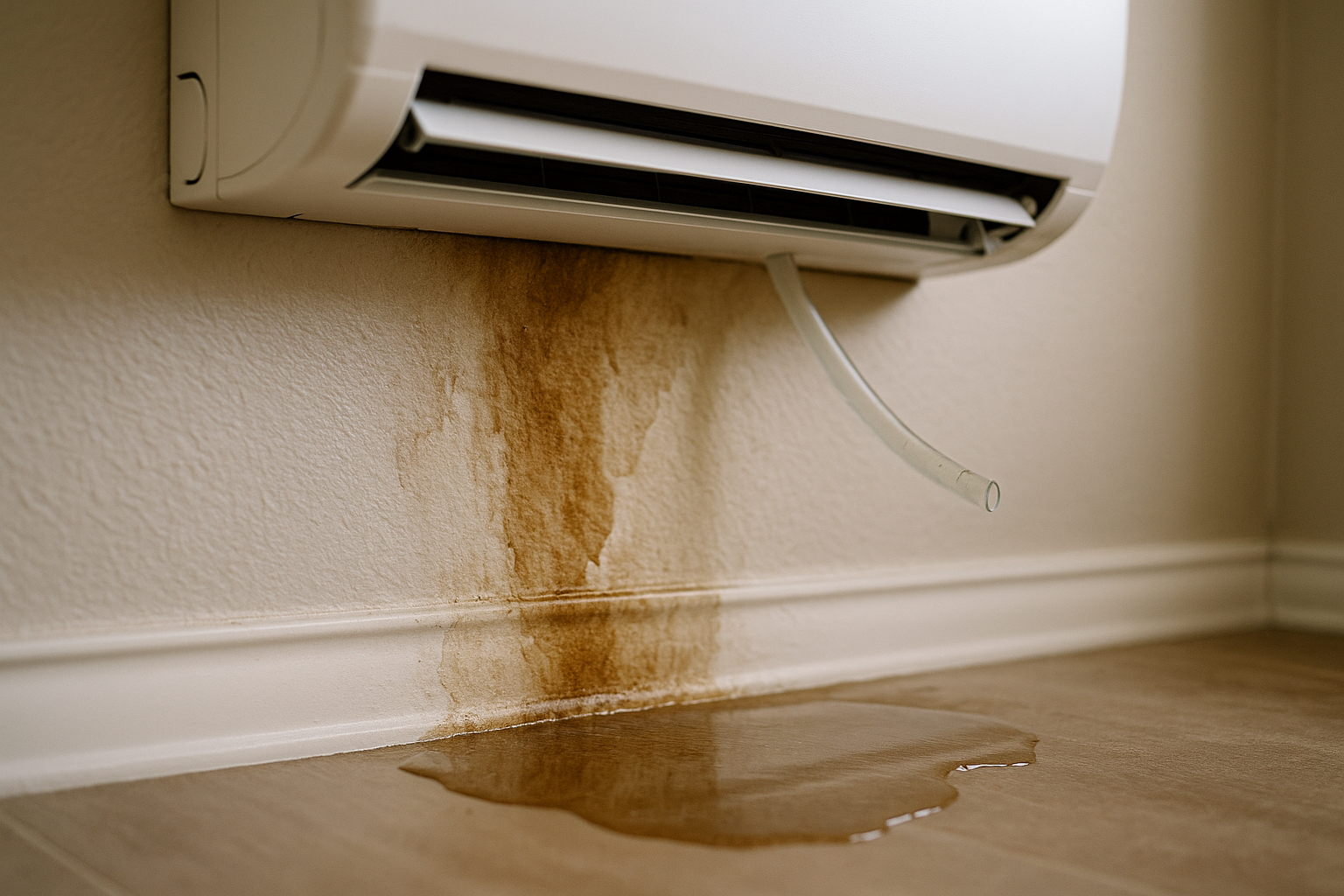
    • Check ceilings under attic units for staining or soft spots. A yellowish ring or a spongy patch on drywall is often the first visible sign of a slow leak that’s been building for hours or days.
    • Find your emergency shutoff switch. Most units have a float switch that should shut the AC off automatically if the pan fills, but it’s worth knowing where the breaker or disconnect is, just in case.
    • If you see active dripping, turn the system off and call for help. Running it longer just adds more water to a problem that’s already started.

    What NOT to do

    If you do find water, please don’t try to “wait it out” until the heat breaks. A saturated ceiling or wall doesn’t dry on its own just because the AC finally catches a break, and left alone, that moisture is exactly what invites mold to take hold. Once drying equipment is in place, it needs to keep running, even though the fans are loud and honestly a little annoying. I know that’s not what anyone wants to hear during an already miserable heat wave, but it’s the part that protects your home from a much bigger, much more expensive problem down the road.

    If something’s already dripping tonight

    Here’s the honest truth: I can’t promise a night like this won’t be disruptive if you do find a leak. What I can promise is that the first hours matter more than almost anything else. Getting water stopped, extracted, and drying started quickly is what keeps a small, cheap problem from becoming a big, expensive one.

    Merlene Mitigation is a small, local, owner-operated company based right here in Pilot Point, and Josh personally handles inspections and water damage calls throughout Cross Roads and the surrounding area. No call center, no subcontracted stranger, just one accountable person who’ll walk you through exactly what’s happening and why. Because there’s no big overhead here, that personal attention comes without the big-company price tag.

    If you’re dealing with a leak tonight, or you just want a second set of eyes on that drain line before the heat warning lifts, you can call or text Josh directly. If he doesn’t pick up right away, it’s likely because he’s already on a job, he’ll call back with an ETA as soon as he’s free.

    And if tonight’s all clear for you, that’s great, take the two minutes to grab our free guide, The First 24 Hours After Water Damage, so you know exactly what to do if a night like this ever catches you off guard.

    Stay cool out there, Cross Roads.

    -Ally

  • AC Condensation Leaks in Cross Roads, TX: What to Check Now

    AC Condensation Leaks in Cross Roads, TX: What to Check Now

    If you’re in Cross Roads today and your AC has been running nearly nonstop, I want you to do one thing before you keep reading: go look at your indoor unit. A heat advisory with a heat index near 108° is exactly the kind of stretch that pushes AC systems past their limit, and condensation drain lines are one of the first things to fail when a system runs this hard for this long.

    Here’s the good news. Checking it takes about three minutes, and it might save you from coming home to a soaked ceiling or a warped hallway floor tomorrow.

    Why heat like this causes water damage, not just high bills

    Your AC doesn’t just cool the air, it pulls moisture out of it. All that moisture has to go somewhere, and normally it drains out through a small condensate line, either into a drain pan, out an exterior line, or into your plumbing.

    When it’s 108° outside, your system runs longer and harder to keep up, which means it’s pulling more moisture out of the air than usual, more often. A drain line that’s been slowly building up algae or dust all summer suddenly can’t keep pace. It backs up. And once it backs up, that water doesn’t stay politely in the pan. It finds the nearest ceiling, wall cavity, or closet floor.

    This is one of the sneakier ways water damage happens in North Texas. No storm, no burst pipe, just a hardworking AC system and a clogged line, quietly doing damage for hours before anyone notices.

    Your 3-minute check, right now

    • Find your indoor unit — usually in a closet, attic, or utility room.
    • Look at the drain pan underneath it. Any standing water, even a little, means the line isn’t draining properly.
    • Check the PVC drain line coming off the unit. Follow it to where it exits outside, often near your outdoor condenser or through an exterior wall. Water should be dripping or flowing there when the AC is running. If it’s bone dry while the system is cooling, that’s a red flag — the water is going somewhere else.
    • Look up. If your unit is in the attic, check the ceiling below it for any soft spots, discoloration, or a fresh water stain.
    • Feel around the base of the unit and nearby drywall for dampness or a musty smell.

    If you see standing water in the pan or dampness anywhere nearby, that line is likely clogged or already overflowing. Turning the thermostat down further won’t help — it’ll just make the unit work harder and push more water through a line that’s already struggling.

    What to do if you find a problem

    If you catch it early, a clogged condensate line is a fairly simple fix for an HVAC tech. The real risk isn’t the clog itself, it’s what happens when it goes unnoticed for a day or two: soaked insulation, stained ceilings, and moisture sitting inside your walls where you can’t see it — which is exactly the kind of thing that turns into a mold problem if it dries on its own timeline instead of the right one.

    If you’re already seeing active water damage — a wet ceiling, water coming through a light fixture, or standing water on the floor — that’s not a wait-and-see situation. The faster water gets extracted and the area starts drying properly, the smaller and cheaper the whole thing stays.

    If it’s already happening

    I’ll be honest with you: I can’t promise a heat-advisory week like this one won’t be disruptive. What I can promise is that if you call, you’re getting one person — Josh — who shows up, assesses it honestly, and tells you exactly what needs to happen and why. No call center, no stranger subcontractor, no upsell. Just a straight answer from someone who treats your house like it matters, because it does.

    If you’re in Cross Roads, Pilot Point, or anywhere nearby and you’re looking at water you didn’t expect, give Josh a call or send a text — texting is often the fastest way to reach him, especially midday when he may already be on another job. He’ll get you an honest ETA and a plan.

    And if today’s a good day and nothing’s leaking, that’s the best time to get ready for the day something does. Our free guide, The First 24 Hours After Water Damage, walks through exactly what to do in that first critical stretch — no pressure, just the plan, so you have it before you ever need it.

    -Ally

  • AC Condensation Leaks in Cross Roads, TX: What to Watch

    If you’ve walked past your air conditioner this week and heard it running almost nonstop, that’s not your imagination. With heat index values hitting 102° across North Texas through Friday, every AC system in Cross Roads is working about as hard as it ever will this year. And when an AC works that hard, it makes a lot more condensation than usual — condensation that has to go somewhere.

    Most of the time, it goes right where it’s supposed to: down a drain line and out of your house. But this is exactly the kind of week when drain lines clog, drain pans overflow, and homeowners find water where they never expected it — a ceiling stain, a damp closet, a puddle by the water heater closet where the air handler lives.

    Why extreme heat makes AC leaks more likely

    Your air conditioner doesn’t just cool your house — it pulls moisture out of the air, and that moisture has to drain away. On a mild day, that’s a manageable amount of water. On a 102° heat index day, your unit runs longer hours and pulls a lot more moisture, which means a lot more condensate flowing through that drain line.

    If there’s already a little algae buildup, a little dust, or a slightly sagging pan, extreme heat is what pushes a minor drainage issue into an actual overflow. It’s not that anything broke overnight — it’s that the system finally hit its limit under the added load.

    The most common signs of an AC drainage problem

    • A musty smell near a closet, attic access, or wherever your air handler is located
    • A ceiling stain or soft spot below an attic-mounted unit
    • Water pooling around the base of the indoor unit
    • The AC suddenly shutting off on its own (many systems have a safety switch that kills the unit when the pan overflows — that’s actually a good thing, and worth knowing about)
    • Higher humidity indoors even with the AC running

    Any one of these is worth a look today, not next week. Water damage from a slow AC leak is sneaky — it often builds for days before it’s obvious, quietly soaking insulation, drywall, or subfloor the whole time.

    What you can actually do right now

    A few simple habits go a long way toward AC overflow leak prevention, especially during a stretch like this one:

    • Check your drain line’s outdoor discharge point. If it’s not dripping at all during a hot, humid stretch, that can be a sign of a clog upstream.
    • Look at your indoor drain pan** if you can access it safely — is there standing water?
    • Change your air filter if it’s been more than a month or two. A dirty filter restricts airflow, which can contribute to drainage issues.
    • Have a plumber or HVAC pro flush the line if you haven’t in a while. This one’s genuinely a DIY-friendly maintenance item for a lot of homeowners, and I’d rather tell you that honestly than talk you into a call you don’t need.

    Where it stops being DIY: once water has actually gotten into drywall, flooring, insulation, or a ceiling, the surface drying out doesn’t mean the structure underneath is dry. That’s where hidden moisture likes to hide, and it’s exactly the kind of thing that turns into a mold conversation a few weeks later if it’s not handled right.

    If you’re already looking at water damage

    If you’ve found actual water — not just a damp filter, but real water damage on a ceiling, wall, or floor — the first move is simple: figure out how far it’s traveled, and get it drying quickly. The longer it sits, the more it spreads and the more it costs to fix.

    I can’t promise the process won’t be a little disruptive — drying equipment isn’t quiet, and nobody loves having fans running in their living room for a few days. But I can promise to make it as least disruptive as possible, and to be straight with you about what’s actually needed and what isn’t.

    Merlene Mitigation is a small, local, owner-operated company based right here in Pilot Point. Josh personally handles the water damage inspections and mitigation work in Cross Roads and the surrounding area — no big-company overhead, no stranger showing up who’s never met you. Right now, through August 6th, we’re offering a free water damage inspection for North Texas homeowners who want a second set of eyes before they decide anything.

    If you’re dealing with a leak today, call or text Josh directly — many folks prefer texting, and that’s just fine. If nothing’s actively wrong but you want to be ready in case it ever is, grab our free guide, The First 24 Hours After Water Damage. It walks through exactly what to do in the first hour of a leak, before help arrives — genuinely worth five minutes of your time, heat index or not.

    -Ally

  • AC Condensation Leaks in Cross Roads, TX: Act During Peak Heat

    AC Condensation Leaks in Cross Roads, TX: Act During Peak Heat

    If your AC has been running nonstop the last couple of days, here’s a question worth asking: have you checked around the unit for water?

    With Cross Roads sitting at 97° today and another scorcher expected Sunday at 96°, air conditioners across North Texas are working about as hard as they ever will this year. And when an AC system runs that hard for that long, condensation lines are exactly the kind of thing that quietly fail.

    Here’s why the next 48 hours matter more than you’d think, and what to actually look for.

    Why Extreme Heat Causes AC Overflow

    Every central AC system pulls moisture out of the air as it cools your home. That water is supposed to drain away through a condensate line, usually into a drain pan and out through a small PVC pipe near your outdoor unit or attic air handler.

    When it’s 97° outside, your system runs longer cycles, more often, which means it’s pulling more moisture out of the air than usual. More moisture means more condensation. More condensation means more strain on a drain line that may already have some algae buildup, a small clog, or a slight sag from age.

    Add all that up, and peak heat days are when condensate lines that have been “fine for years” finally overflow.

    Where to Actually Look

    • The drain pan under your attic air handler, if you have one — check for standing water or staining on the wood around it
    • The ceiling directly below an attic unit — a yellowish-brown stain or soft spot is often the first sign
    • The wall or floor near an indoor closet unit
    • The PVC drain line outside near your outdoor unit — is it actually dripping, or bone dry?
    • Musty smell in a room that didn’t have one last week

    None of these take more than five minutes to check, and doing it today, while the heat is at its peak, is exactly when you’re most likely to catch a problem before it becomes a bigger one.

    Why Speed Actually Matters Here

    A slow AC leak is sneaky because it doesn’t look like much at first. A little water in a drain pan, a faint stain on the ceiling — it doesn’t scream emergency. But condensation leaks often happen inside a wall cavity or above a ceiling, out of sight, for days before anyone notices. That’s exactly the kind of quiet, ongoing moisture that mold loves.

    This is one of those situations where “it looks fine” and “it is fine” are two different things. Surface materials can look dry while the wood, insulation, or drywall behind them are still holding water. That’s not a scare tactic, it’s just how moisture and building materials actually behave.

    If you do find water today, here’s the honest, no-drama version of what should happen next: get the source stopped (usually means shutting the system off or calling an HVAC tech to clear the line), get the standing water up, and get the area assessed for how far the moisture actually traveled. The first 24-48 hours after any water event are about stabilizing things and starting to dry, then reassessing once the picture is clearer. That rhythm applies just as much to a quiet AC drip as it does to a burst pipe.

    What This Isn’t

    To be clear, most AC condensation issues in Cross Roads this weekend won’t turn into anything serious. A quick check, maybe a line that needs clearing, and you’re done. I’d rather you look and find nothing than not look and find a soft ceiling in three weeks.

    And if you do find something and you’re not sure how serious it is, that’s a completely normal thing to want a second set of eyes on. I’d rather answer a question that turns out to be nothing than have someone sit on real water damage because they weren’t sure it was “bad enough” to call.

    If You’re in Cross Roads or Nearby

    Merlene Mitigation is based just down the road in Pilot Point, and we’re currently offering free water damage inspections through August 6th, 2026. No pressure, no upsell — just an honest look at what’s going on and straight answers about what it means for your home.

    You can call or text Josh directly if you’d rather not deal with a phone tree — a lot of folks prefer texting, and that’s just fine. One person answers, one person shows up, and one person stays accountable for getting it right.

    And if nothing’s wrong today but you want to be ready in case something happens down the road, our free guide, The First 24 Hours After Water Damage, walks through exactly what to do in that first critical window — worth five minutes now so you’re not scrambling later.

    -Ally

  • AC Condensation Leaks in Cross Roads, TX: Act Now

    AC Condensation Leaks in Cross Roads, TX: Act Now

    Right now, somewhere in Cross Roads, an AC unit is running nearly nonstop trying to keep up with a 110° heat index — and its condensation drain line is quietly clogging with the algae and gunk that builds up all summer. Nobody notices until water is dripping through a ceiling or pooling around a closet air handler. If your AC has been working overtime this week, this is the moment to pay attention.

    Why this heat wave is different for your AC

    Every air conditioner pulls moisture out of the air as it cools your home. That moisture has to go somewhere — usually down a small condensate drain line to the outside or a floor drain. On a normal day, that’s a manageable trickle.

    But during a multi-day heat advisory like this one, your system runs far longer and far harder than usual. More run time means more condensation produced, hour after hour, with barely a break. A drain line that was “just barely” keeping up in June can back up fast when it’s asked to handle this much water this many hours in a row.

    That’s the real risk with extreme heat: it’s not just uncomfortable, it’s the exact condition that turns a slow, hidden clog into a real water intrusion event.

    What an AC condensation leak actually looks like

    These leaks are sneaky because they usually start small and out of sight — inside a closet, above a ceiling, or behind a wall where the air handler or ductwork lives. Here’s what to check today, especially if your system has been running nonstop:

    • A musty or damp smell near a closet, hallway, or attic access
    • A ceiling stain or soft spot, especially below an attic-mounted air handler
    • Water or a puddle around a floor-mounted indoor unit
    • The drain pan overflow switch tripping and shutting your AC off (a good safety feature doing its job)
    • Visibly slow or standing water in the clear PVC condensate line, if yours is visible

    If you catch any of these today, don’t wait it out. Hidden moisture behind drywall or under flooring doesn’t dry on its own, and it doesn’t wait for a convenient time to become mold.

    A quick, honest note on prevention

    You can often flush a condensate line yourself with a wet/dry vac at the outside termination point, and a lot of homeowners do this as basic seasonal maintenance. I’d never tell you to pay someone for something you can safely do yourself. But if you’ve already got standing water, a stained ceiling, or you’re not sure how far the moisture has traveled, that’s a different situation — one where guessing wrong costs a lot more than calling to check.

    If water has already gotten in

    The first hours matter more than people realize. The goal on day one is simple: get the water out, get airflow and dehumidification on the wet materials, and stabilize the area so it stops spreading. A full plan for repairs comes after a 24–48 hour reassessment, once we can see how the structure is actually drying — not before.

    I know the equipment is loud and the fans are annoying to live with for a few days. I get it. But I won’t ever tell you it’s fine to shut them off early — that’s exactly how a contained leak turns into hidden mold weeks later. What I can promise is that I’ll make the process as least disruptive as possible while it’s running.

    You’re not overreacting

    With a heat advisory stacking days of extreme AC use back to back, this is exactly the window when quiet drain issues turn into real water damage across North Texas. Checking your closet or attic access today isn’t paranoid — it’s the smart, five-minute habit that saves a homeowner thousands.

    If you’re in Cross Roads, Pilot Point, or anywhere nearby and you’re seeing signs of a leak, or you just want a second set of eyes before it becomes a bigger problem, give me a call. I’m running free water damage inspections through the end of the month, no pressure, no obligation — just an honest look and a straight answer about what you’re dealing with.

    -Ally