
Tag: ac condensation leaks

  • AC Condensation Leaks in Denton, TX: Why 105° Heat Causes Failure

    AC Condensation Leaks in Denton, TX: Why 105° Heat Causes Failure

    If you can hear your AC running almost nonstop today, you’re not imagining it. With the heat advisory in place and the heat index pushing 105° across Denton County, every air conditioner in North Texas is working harder than it was designed to work for hours at a stretch. And when an AC system runs that hard, that long, something else starts working overtime too: your condensation drain line. Today’s the day it’s most likely to fail — and it can do it quietly, behind a wall, for hours before anyone notices.

    Why heat like this causes leaks, not just discomfort

    Your AC doesn’t just cool air — it pulls moisture out of it. That moisture collects as condensation and is supposed to drain out through a small line, usually PVC, that runs from the indoor unit to the outside of your house.

    On a normal day, that line handles a manageable amount of water. On a 105° heat index day, your system is running longer cycles, pulling more moisture out of the air for more hours in a row, and pushing more water through that same small line. If there’s even a partial clog — algae, dust, a bit of debris — today is the day it backs up and overflows.

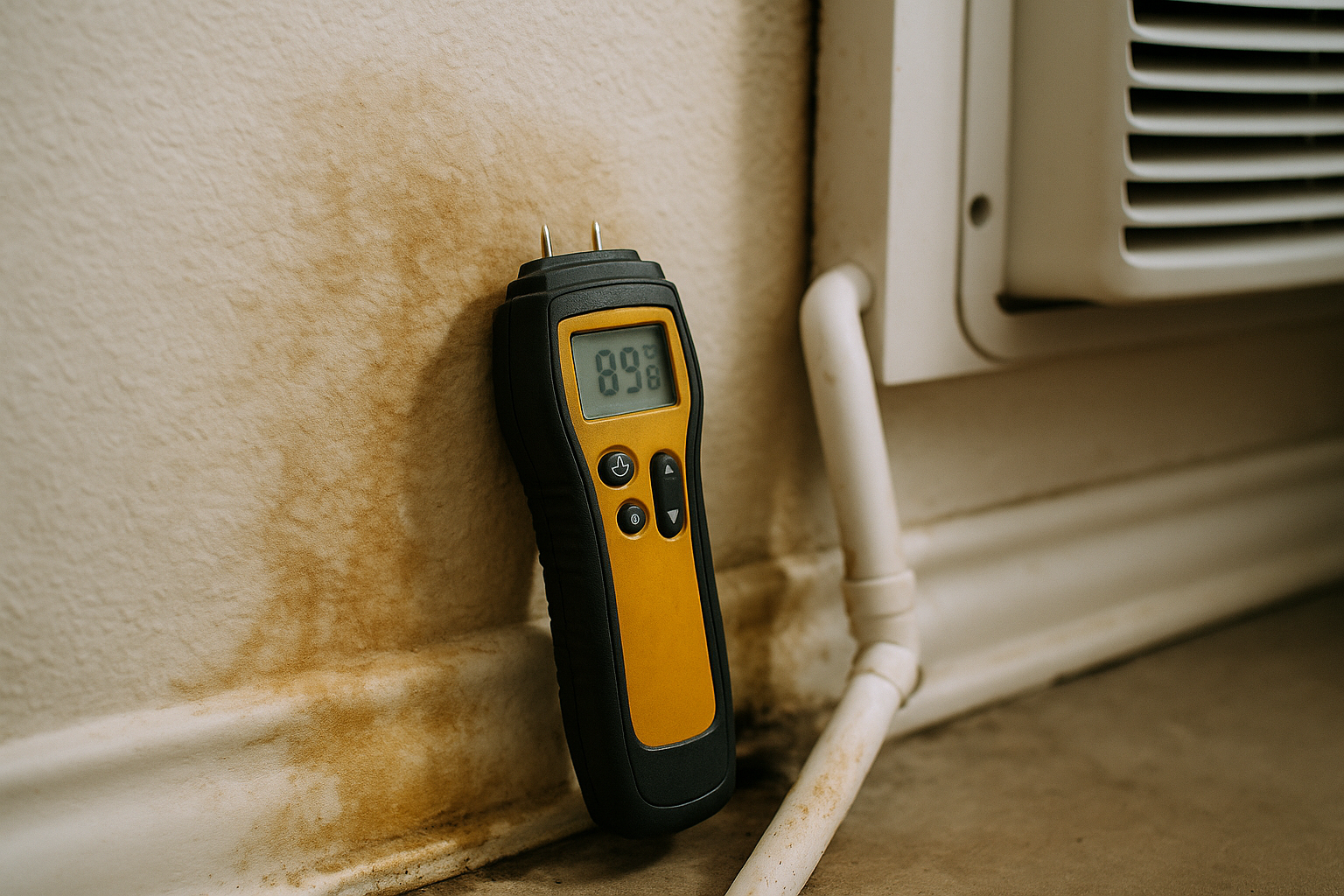
    That’s the quiet part of an AC overflow. It doesn’t announce itself with a bang. It shows up as a stain on the ceiling below the attic unit, a damp spot near the closet where your indoor unit lives, or water pooling in the drain pan and finding its way past it. By the time you see it, it’s often been dripping for a while.

    What to check today, right now

    None of this takes special tools — just a few minutes and a flashlight.

    • The drain pan under your indoor unit. If your unit is in a closet or attic, look for standing water in the pan or on the floor around it.
    • Ceiling below the attic unit. A yellowish stain, a soft or sagging spot, or new discoloration is a sign water has already found its way through.
    • The outdoor drain line termination. This is usually a white PVC pipe near your outdoor unit. Water should be dripping from it steadily on a day this hot. If it’s bone dry while your AC is clearly running, that’s a red flag — the water may be backing up somewhere else instead.
    • Musty smell near vents or closets. Moisture sitting behind drywall or under flooring often announces itself with smell before it shows visibly.
    • Your float switch, if you have one. Some systems have a safety switch that shuts the AC off when the pan overflows. If your AC suddenly stopped cooling on a day this hot, this could be why — and it’s actually doing its job.

    If you find water

    Don’t panic, but don’t wait, either. A small leak today can mean saturated drywall, insulation, or subfloor by tomorrow — and once that happens, it’s not something a fan and an open window will fix. Moisture trapped inside a wall or under flooring needs real drying equipment to pull it out fully; surface-dry isn’t the same as structure-dry, and that gap is exactly where hidden mold risk lives.

    If you catch it early, turn the AC off at the thermostat to stop feeding the leak, mop up what you can see, and get eyes on it — either an HVAC tech for the mechanical side, or a water damage professional if there’s already saturation in drywall, flooring, or insulation.

    We’re here if today’s the day

    I’m not going to pretend I know whether this is a five-minute clog or something that’s already spread further than it looks — that’s exactly what an inspection is for. Josh has been doing this work for over 12 years, and he’ll tell you straight what he’s seeing and what it actually needs, not what’s easiest to sell.

    Merlene Mitigation is based right here in Pilot Point, and Josh personally handles every water damage inspection — no call center, no subcontractor you’ve never met. That keeps things honest, and it keeps the price fair.

    If you’re in Denton or anywhere in North Texas and you’re looking at a wet drain pan or a stained ceiling right now, call or text Josh. He’s typically on-site within the hour for situations like this.

    And if today isn’t your emergency but you want to know exactly what to do the moment it is, grab our free guide, The First 24 Hours After Water Damage. It’s the same plan we’d walk you through on the phone — just ready before you need it.

    -Ally

  • AC Condensation Leaks in Gunter, TX: 107° Heat Causes Hidden Water Damage

    AC Condensation Leaks in Gunter, TX: 107° Heat Causes Hidden Water Damage

    If your AC has been running nonstop since sunrise and you noticed a musty smell near a vent, or a faint water stain creeping across a ceiling tile — please don’t wait until Monday to look into it. With the heat index sitting at 107° today and staying there through the weekend, this is exactly the kind of stretch that causes AC condensation leaks in Gunter, TX and across North Texas. And a lot of that damage happens quietly, inside a wall or attic, long before anyone notices a drip.

    Why extreme heat causes AC drain backups

    Your air conditioner isn’t just cooling air — it’s pulling moisture out of it, especially on brutal, humid days like this one. That water is supposed to travel down a small condensate drain line and exit safely outside. But when your unit is working overtime for days straight, a few things happen:

    • More condensation is produced than usual, faster than the line is used to handling
    • Algae, dust, and gunk that’s been sitting in the drain line finally gets pushed into a clog
    • The drain pan fills faster than a slow leak or crack can keep up with

    The result is an AC drain backup — water finds the path of least resistance, and that’s often down into a ceiling, along an attic floor, or behind a wall near your air handler.

    Why this kind of leak is so sneaky

    A burst pipe announces itself. A condensation leak doesn’t. It’s usually slow, small, and hidden in a space you don’t check every day — an attic, a closet with the air handler, above a garage. That’s what makes hidden water damage during extreme heat so much more dangerous long-term than it looks in the moment. By the time you see a stain or smell something musty, there’s a good chance moisture has been sitting in insulation or drywall for a while already.

    Surfaces dry fast. What’s underneath doesn’t. That gap is where mold risk and real structural damage live.

    What to check right now, today

    This takes ten minutes and it’s genuinely worth doing during a heat advisory like this one:

    • Look at your indoor unit or air handler closet. Any water on the floor, staining, or a musty smell?
    • Find your condensate drain line (usually a white PVC pipe near your outdoor unit). Is water actively dripping from it? A little drip is normal on a hot day like today — no drip at all when the AC is running hard can actually be a sign of a clog.
    • Check the emergency shut-off float switch if your system has one — it should stop the AC before an overflow, but it’s not foolproof, especially on an older system.
    • Look at ceilings below the attic and around vents for any new discoloration, sagging, or soft spots.

    If you find standing water, a backed-up pan, or a stain that’s spreading — turn the AC off at the thermostat, call an HVAC tech to clear the line, and don’t run the system again until it’s confirmed clear. That part’s on the HVAC side, not us — but it’s the right first move to stop the source.

    If water’s already gotten into the structure

    Once water has actually reached drywall, insulation, or subfloor, this becomes our part. The reason we push people to check now, during a stretch like this weekend’s, is that catching it early is the difference between a small, contained dry-out and something that spreads into a bigger, more expensive repair.

    I can’t promise it won’t be disruptive to have drying equipment running for a few days — but I can promise we’ll make it as least disruptive as possible, and we’ll walk you through exactly what’s happening and why, every step.

    Josh handles every inspection and every job personally — there’s no call center, no rotating crew of strangers, just one accountable local guy who lives in Pilot Point and answers his own phone. That keeps overhead low, which means fair prices, and it means the person who inspects your home is the same person who’s still checking in on it three days later.

    A quick, free step this week

    Through July 29th, we’re offering free water damage inspections for anyone in Gunter and the surrounding area who wants a second set of eyes on a stain, a smell, or just peace of mind after a run of heat like this. No pressure, no pushy sales pitch — just an honest look and a straight answer about whether it’s something to watch or something to act on.

    If you’re in Gunter, Pilot Point, or anywhere in North Texas and this weekend’s heat has you wondering about your AC or a spot on the ceiling, give us a call. I’d rather you check and it be nothing, than skip it and find out the hard way in August.

    -Ally